PolySat crew gathered before dawn for the university’s first satellite launch in five years, then headed back to campus to listen for its first signals from space
The fog was so thick that, at first, the Cal Poly students could only listen.
Roughly 30 of them had gathered along Ocean Avenue in Lompoc around 3 a.m. on March 30, staring into the dark and following the SpaceX livestream on their phones. They had driven down from San Luis Obispo to watch a shoebox-sized, student-built satellite rise from Vandenberg Space Force Base, carrying years of their work into orbit.
About 15 seconds before liftoff, the group went quiet.
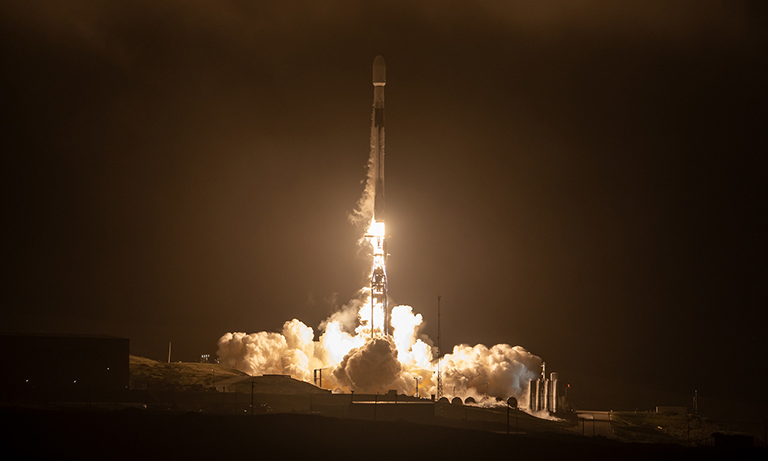
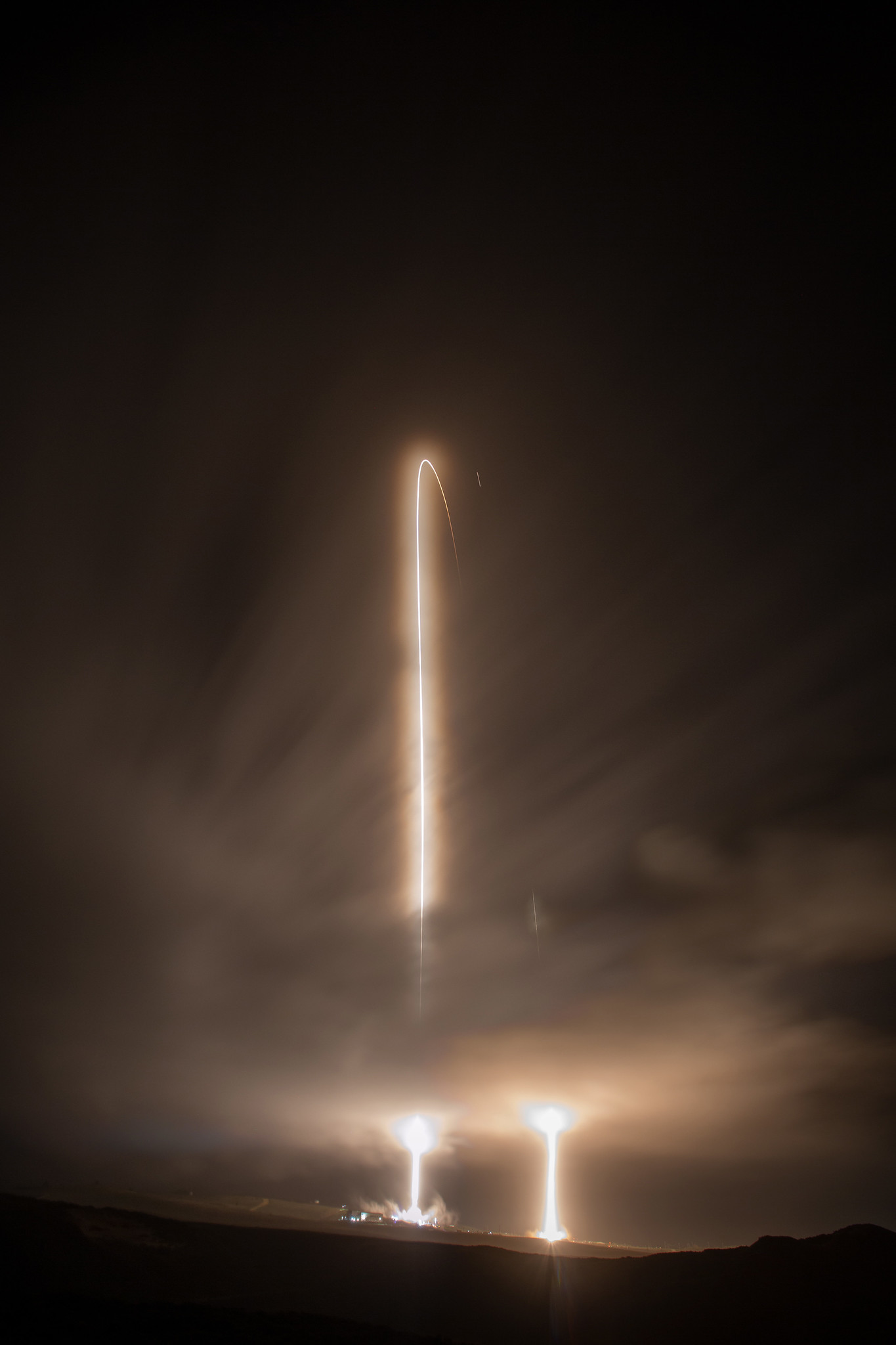
As the final seconds ticked down, students counted aloud together. At 4:02 a.m., the rocket lit the sky. The glow cut through the fog first, bright enough to make it feel like daylight. Then came the roar. A moment later, the Falcon 9 emerged from the clouds.
Jess Bleakley, lab manager for Cal Poly’s PolySat Lab, still remembers the sequence clearly: first the light, then the sound, then the reaction all around her.
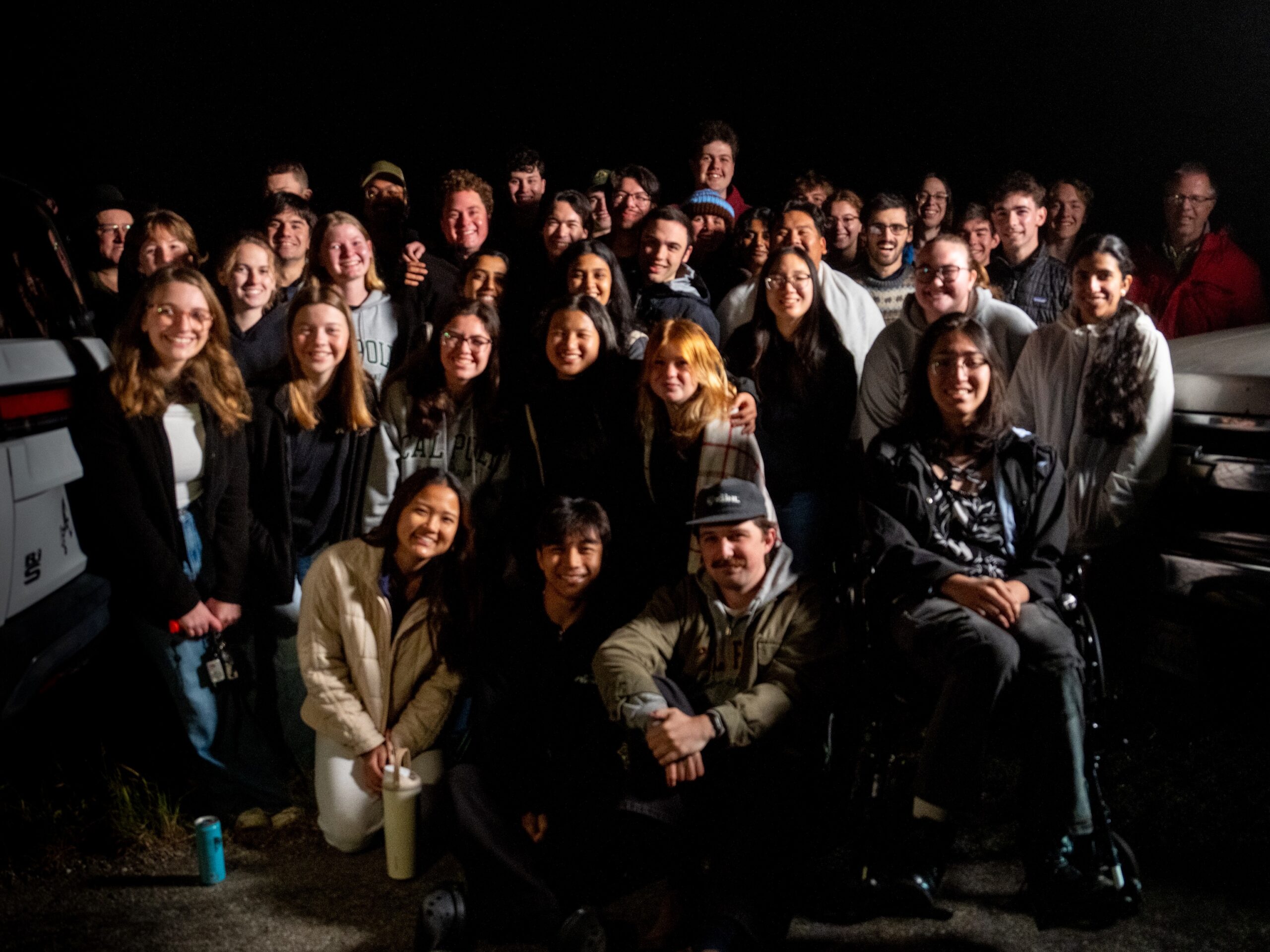
Shouts and laughter rose around the group as hands flew into the air. Students turned toward each other, pulling into quick hugs and slapping high-fives in the dark. Some in the group were watching a rocket launch for the first time. Bleakley, an aerospace engineering senior, was watching the rocket lift away with a satellite small enough to hold in her hands but one that had become central to her college experience.
“It’s wild that my entire college career is wrapped up in something the size of a loaf of bread,” she said.
SAL-E is Cal Poly’s first CubeSat launch in five years. Named in honor of Sally Ride and dedicated to CP1 and CP2 — the university’s first CubeSats — it carries two student-developed payloads that will test computing and communications technologies in orbit.
As the Falcon 9 disappeared into the fog, the focus was already shifting back to campus, where students were preparing to fill shifts around the clock and track the spacecraft’s health one brief ground pass at a time.
Listening for SAL-E
Getting SAL-E to space was only part of the challenge. The satellite still had to call home.
A few hours later, several PolySat members were in Professor Kira Abercromby’s space environments class on the first day of spring quarter. Running on little sleep, they were looking over their syllabi and watching a satellite-tracking page for any sign from orbit.
Then Drew Stannard-Stockton, the lab’s ground stations lead and an aerospace engineering junior, interrupted with the news. An amateur radio operator in Australia had picked up SAL-E’s first signal, not through Cal Poly’s own equipment yet, but enough to tell the team what it needed to know: SAL-E was transmitting.
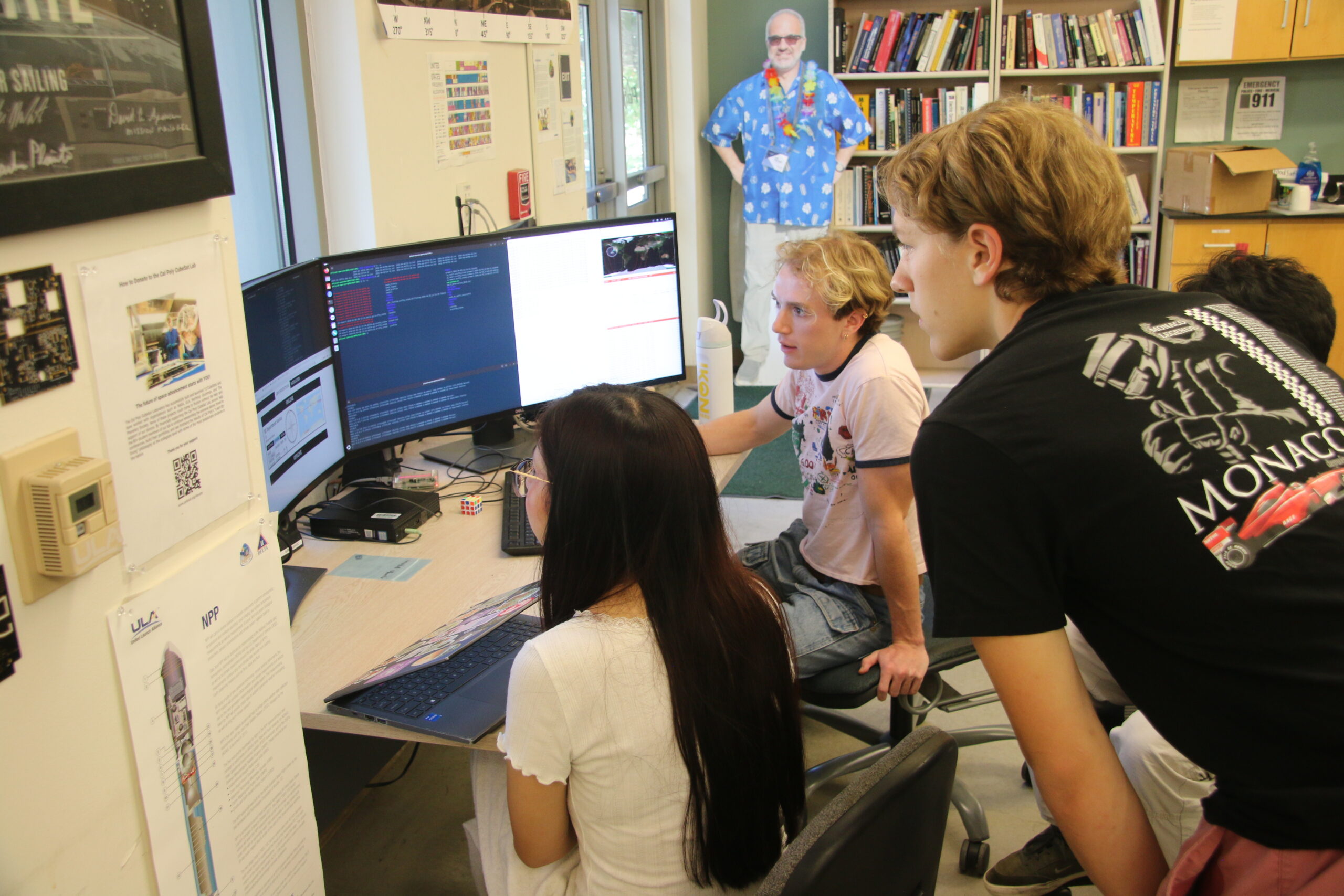
Later that afternoon, students crowded into the lab for SAL-E’s first pass over California, their first chance to hear directly from the satellite through Cal Poly’s own ground station and begin gauging how it was doing in orbit. They were waiting for beacons to come through and offer a basic read on the spacecraft’s health — temperatures, battery status and whether SAL-E was drawing power from its solar cells.

Those windows are short. Most passes last about three minutes, which gives the team only a brief stretch to collect data before the satellite slips past the horizon again.
Stannard-Stockton knows how much depends on those minutes. When he joined the lab, none of the ground stations were fully functional. Over the summer, the team worked to bring them back online, testing radios and controls, simulating a space pass from Bishop Peak and practicing with satellites already in orbit.
Those early passes did not yet allow students to send commands to the satellite, but they did offer an encouraging first read. SAL-E was power-positive, a sign that its solar cells were doing their job.
Bleakley had been among the more cautious members of the team. “I honestly didn’t think it would turn on at all,” she said. “We hadn’t launched a satellite in five years, and we were flying 20-year-old solar cells.”
Running on adrenaline and very little sleep, the team finally had a result that let everyone exhale.

Two Missions, One Moment
Another breakthrough came the following day.
PolySat members were in the lab for an Artemis watch party while preparing for another SAL-E pass. Artemis II is NASA’s first crewed mission around the moon in more than 50 years. The launch carried extra meaning on campus because its pilot, Victor Glover, is a Cal Poly engineering alumnus.
Just two minutes after Artemis II lifted off, the PolySat team established two-way communication with SAL-E for the first time. Students could do more than listen now. They could begin sending commands to the satellite and, once its orbit was fully established, prepare to activate the payloads already aboard.
Kayla Wong, SAL-E’s mission lead and an aerospace engineering junior, had spent months helping push the flight unit through hard deadlines and high-stakes problem-solving. So when SAL-E answered back just after Artemis II lifted off, the timing felt symbolic. In different ways, both launches marked a return. Bleakley saw the moment in similarly cosmic terms. “I feel like the stars have aligned,” she said.
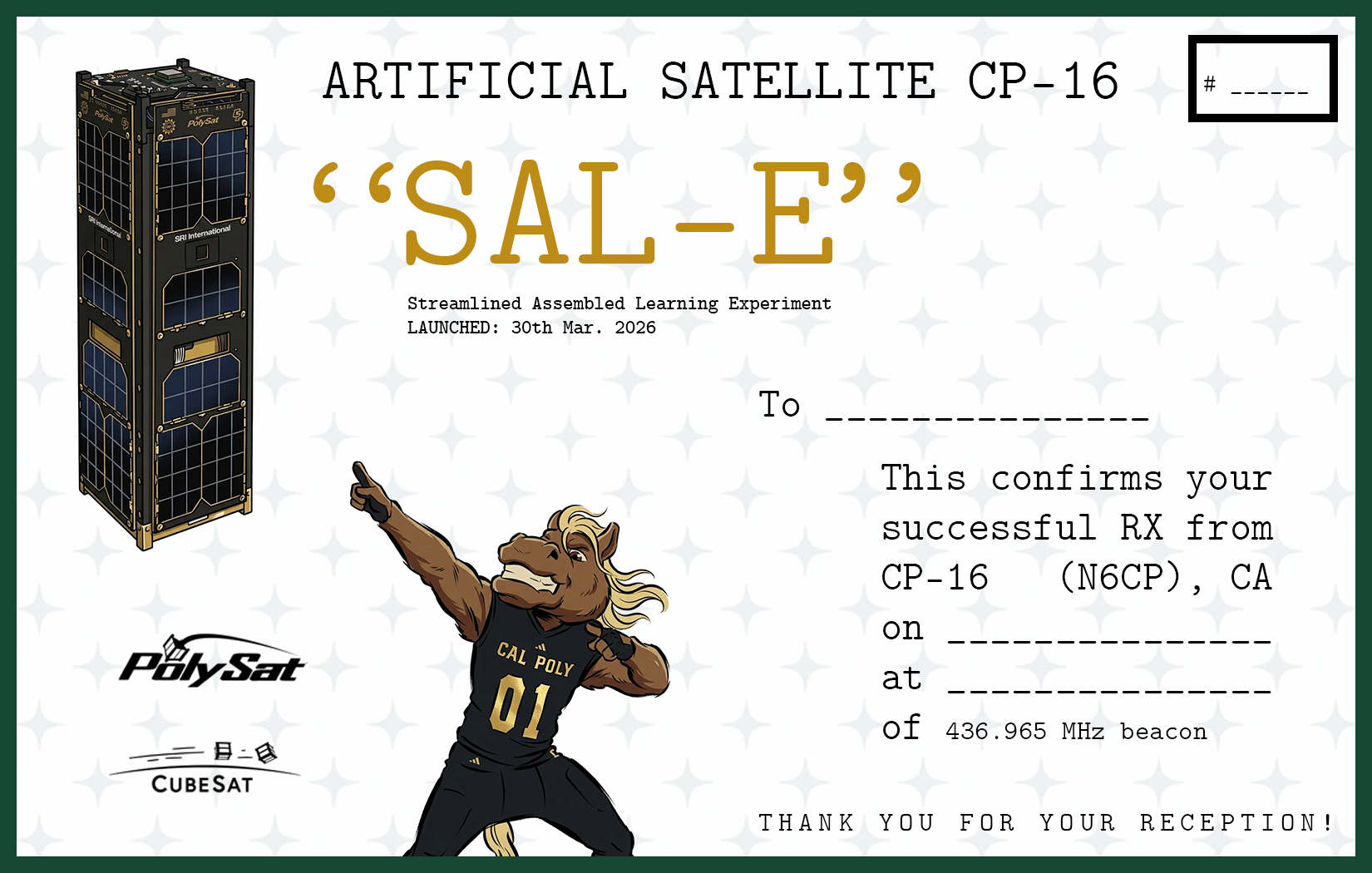
In the CubeSat Lab, SAL-E is more than a successful launch and a healthy first contact. It marks a return to orbit for a program that helped shape the small-satellite movement. Dedicated to CP1 and CP2, the first CubeSats built at Cal Poly, SAL-E carries that history with it.
Those first Cal Poly satellites never made it to orbit. In 2006, a Russian rocket malfunctioned after liftoff from Kazakhstan, destroying CP1 and CP2 along with other university-built CubeSats. But the work behind them — part of a CubeSat standard co-developed by Cal Poly professor Jordi Puig-Suari and Stanford professor Bob Twiggs — helped establish a new model for small spacecraft, one that widened access to space and helped turn CubeSats from a fringe idea into a serious platform for research, education and industry.
Back in San Luis Obispo, the mission has settled into a new rhythm. For the first two weeks, students are monitoring every ground pass, cycling through afternoon and predawn shifts as SAL-E moves overhead. Wong said she had worried there would not be enough people to cover them. Instead, every shift filled. When Bleakley showed up for one 4 a.m. pass expecting to find one other person in the lab, she found about eight, eating donuts and waiting for SAL-E to come by.
Stannard-Stockton said the lessons from SAL-E are already feeding into AMDROHP, the lab’s next student-led CubeSat mission. Even now, the shift from launch to aftermath has not quite worn off. The satellite is overhead, the passes keep coming and the students who built it are still in the lab, listening for the next signal. “Something they touched is now in space,” Bleakley said.
By Emily Slater