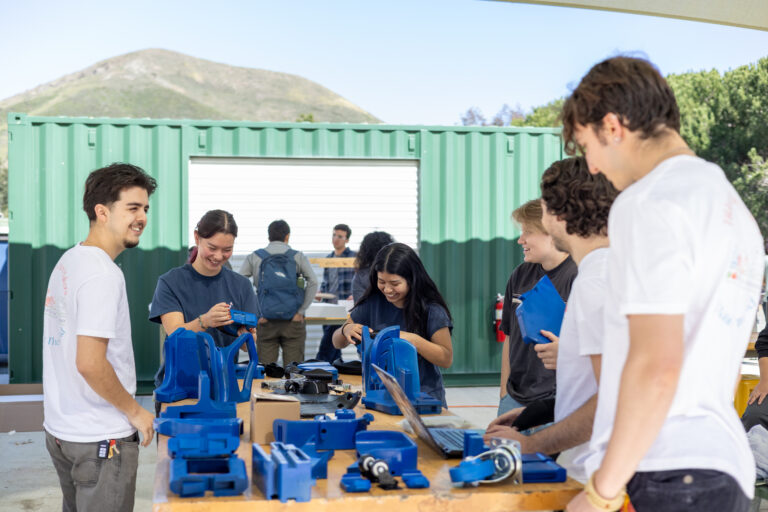
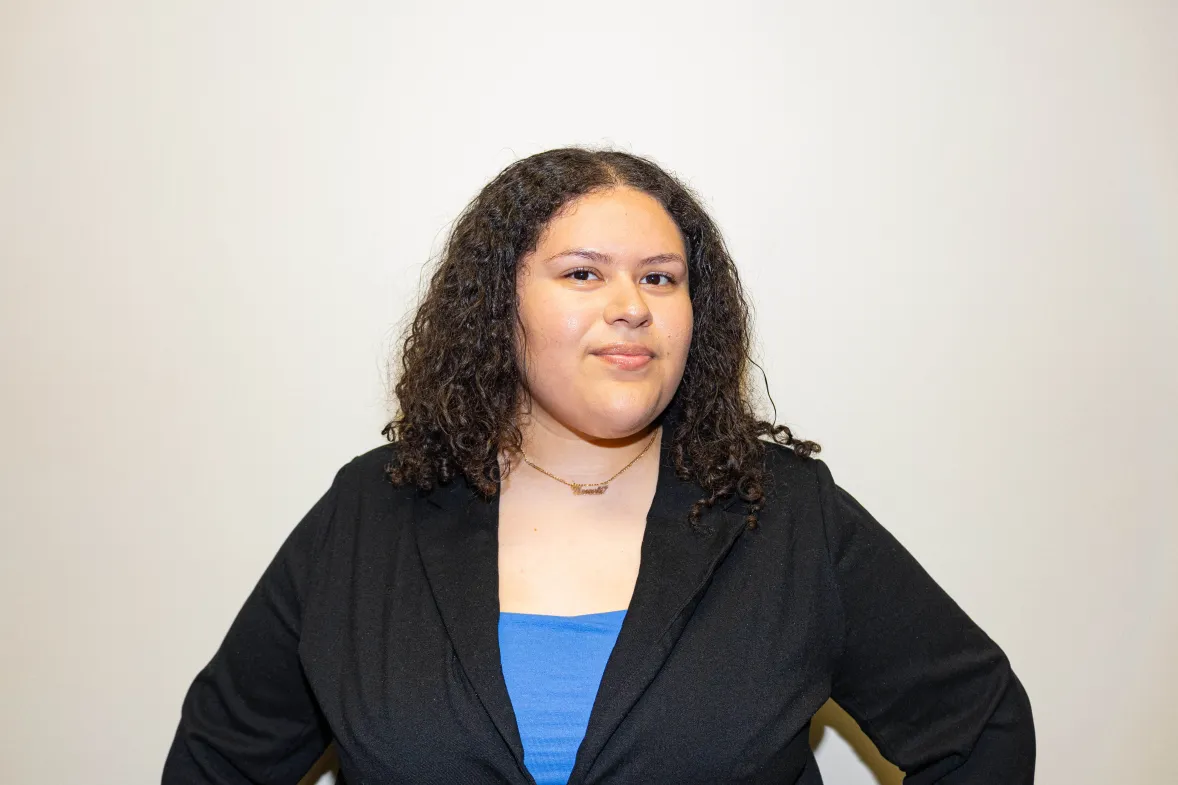
Each week, the College of Engineering features an outstanding member of the engineering community to be part of our spotlight campaign. This week, we are highlighting software engineering student Yaneli Cruz.
What made you choose engineering?
My sister went to the University of California, Berkeley, for mechanical engineering when I was 2 years old, and she always made engineering seem fun and cool, so she quickly became someone I looked up to and wanted to emulate.
What was your earliest engineering project?
My earliest exposure to engineering was in middle school during a science class activity where we had to design an egg drop structure using only a few materials: sticks, an egg, tape, string and a piece of a trash bag. The goal was to build something that could protect the egg when it was dropped from a certain height. What stood out to me wasn’t just the building process itself, but the thought process behind it: thinking about how to absorb impact, how to distribute force and how different designs might affect the outcome.
That experience helped me realize that engineering isn’t just about building things. It’s really a way of thinking. It involves asking questions, forming hypotheses, testing ideas and improving designs based on results. Through that process, I began to see engineering as a mindset centered on curiosity, critical thinking and the scientific method. Even at that age, it showed me that solving problems often means experimenting, learning from failure and refining ideas until you find something that works.
What has been your favorite class and why?
My favorite class so far has been one that I took for my ethnic studies minor, SPAN 350 with Professor René Carrasco. As important as STEM is for innovation and advancement in society, the arts and cultural studies are equally important for the human spirit. They help us understand identity, history and the social forces that shape our communities. Studying the arts and ethnic studies encourages empathy, critical thinking and self-reflection, qualities that are essential not only for being a well-rounded student but also for being a thoughtful and responsible member of society.
What made this class especially meaningful was the way Professor Carrasco challenged us to think deeply about the narratives we have been told our entire lives. Rather than simply memorizing historical events or literary interpretations, he encouraged us to analyze where these narratives come from, whose perspectives they represent and whose voices might be missing. Through discussions and readings, we explored how history and culture are often shaped by those in positions of power, reinforcing the idea that history is written by the victors.
This approach pushed me to move beyond passive learning and actively question and interpret the material. It taught me to look at stories, history and cultural narratives with a more critical lens and to consider how different perspectives can reshape our understanding of the past and present. That intellectual challenge, combined with the opportunity to explore my own cultural background and identity, made SPAN 350 one of the most impactful and memorable classes I have taken so far.
What’s your dream job after graduation?
After graduation, I’d love to be an analyst for the Los Angeles Dodgers. Being from L.A. and having a family that bleeds blue, all I’ve known growing up is Dodger baseball, so it would be very exciting to work at the stadium in day-to-day operations and analytics.
What is your favorite place in San Luis Obispo County and why?
My favorite place is definitely Avila Beach because I love to swim, but anywhere with my friends will always be fun.
What do you think engineering’s biggest impact on the world will be in the future?
Rather than focusing on what I believe engineering will inevitably do in the future, I think the more important question is how engineering should be used. Engineering has the potential to shape the world in ways that prioritize the public good, such as developing solutions that are environmentally responsible, address global challenges like climate change and genuinely improve people’s quality of life. In my view, the greatest impact engineering can have is when it moves beyond building products purely for profit and instead focuses on designing thoughtful, sustainable solutions that respond to what communities actually need, not what we think they need.
Do you have a scholarship?
Yes. I’m currently going into my third straight year as a scholar with the Hispanic Scholarship Federation, and I’ll also be going into my second straight year as a scholar with the National Rainbow College Fund. I also have some scholarships through Cal Poly, including the Gene and Lori Fisher Memorial Scholarship and the Cal Poly Scholars Scholarship.
Are you part of any extracurriculars on or off campus?
Tons! I’m currently a tech officer with Women Involved in Software and Hardware, the social media manager for Color Coded, a mentor with Cal Poly Scholars, a community adviser in continuing student housing, the recording secretary for the coed engineering fraternity Theta Tau and a research scholar through the BEACoN research program.
If you have taken part in an internship recently, would you mind sharing your experience?
Recently, I served as the operations lead intern for the San Luis Obispo County Department of Social Services during the annual Point-in-Time Count, a nationwide effort that collects data on unsheltered homelessness to inform funding and policy decisions. In this role, I coordinated operational logistics for over 200 volunteers across multiple survey locations, developed standardized field protocols for dozens of survey teams and helped test the county’s survey collection app prior to deployment to ensure the data collection process ran smoothly. The experience was incredibly rewarding because I was able to contribute to work that directly impacts people facing homelessness in the community. It showed me how technology, organization and data-driven decision-making can support meaningful social change.
How do you support the college’s commitment to justice, equity, diversity and inclusion?
I support the college’s commitment to justice, equity, diversity and inclusion by working to build spaces where students from all backgrounds feel supported, represented and empowered to succeed in engineering. Through my involvement with Women Involved in Software and Hardware and Color Coded by Color Stack, I help contribute to communities that support students who are historically underrepresented in technology by creating opportunities for mentorship, professional development and connection.
As a mentor with Cal Poly Scholars, I also work directly with first-year students — many of whom come from first-generation or underrepresented backgrounds — to help them navigate the transition to college, connect with resources and build confidence in their academic journey. Additionally, as a community adviser in continuing student housing, I foster an inclusive residential environment where students feel comfortable bringing their full identities into the community.
Across all of these roles, I try to lead by example by encouraging open dialogue, supporting my peers and helping create environments where everyone feels they belong in engineering. I believe that when students feel seen, supported and valued, they are better able to thrive and contribute their unique perspectives to the field.
By Taylor Villanueva