

Cal Poly’s Design, Build, Fly team spent months designing and building a large remote-controlled plane for last year’s SAE Aero Design West, an international collegiate competition. The effort ended seconds after takeoff when the plane crashed, and the team never had the chance to post a flight score.
“It was so disappointing,” said the club’s vice president, Samantha Richert. “But everyone had great attitudes.”
Design, Build, Fly, known as DBF, is a student engineering club that designs, builds and tests a heavy-lift remote-controlled aircraft for an annual competition. Over the course of the season, members move from early design work to fabrication and flight tests. In DBF, every result becomes a data point for the next round of changes.
That mindset mattered when the plane went down. Members treated the crash as feedback and went back to work, revising the plane and narrowing their focus for the 2025-26 cycle. Club President Christopher Imirian said that shift has guided this year’s strategy, with DBF prioritizing reliability and building in more room for error.
In April, the club will return to SAE Aero Design West in Fort Worth, Texas, where 75 teams are judged on their report and presentation, along with how the plane performs in flight. Between now and then, DBF’s work will unfold the way it always does: students learning fast and taking on responsibility early, building an aircraft that must perform beyond the screen and on the runway.
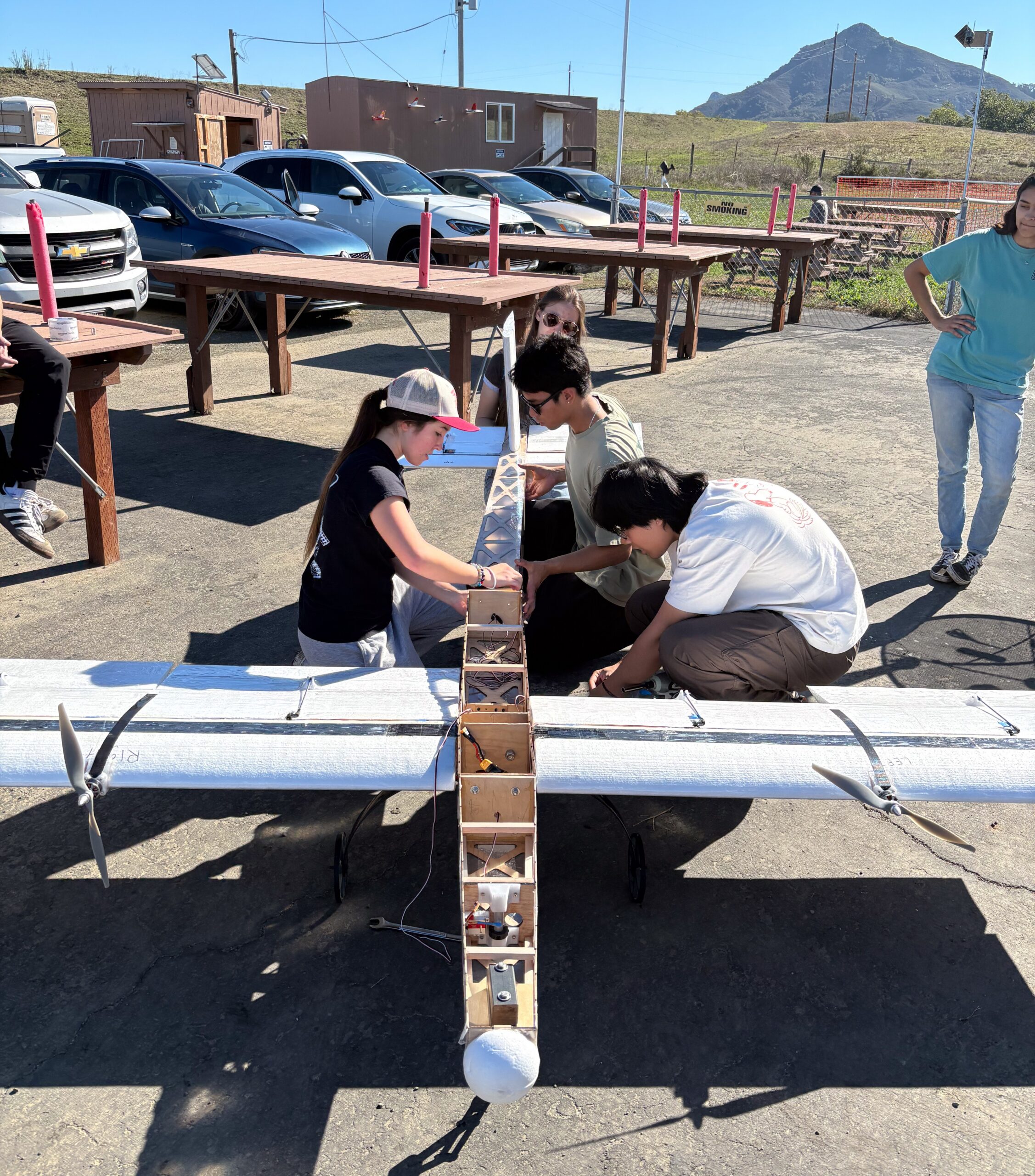
Imirian joined DBF last September, during his third year as an aerospace engineering major, because he wanted more experience with aircraft development beyond the classroom. Richert, an industrial engineering major, found the club earlier, during the winter of her sophomore year, after realizing she wanted a deeper understanding of how planes are built.
“I wanted something tangible to come out of my college experience,” Richert said. She had landed an internship at an aerospace company, but she didn’t yet know what it took to manufacture a plane. “I figured I should know.”
DBF is organized around two teams that mirror the way real projects get built. The flight sciences team focuses on aerodynamics and performance. The structures team translates those ideas into a physical plane that can survive testing and deliver on the runway.
“It takes all of fall quarter to design the wings, fuselage and empennage,” Richert said, including key sizing decisions.
By winter, the project shifts from the digital model to the shop floor. Prototypes and test flights reveal which choices translate once the team starts building and strengthening the plane.
The club has grown quickly in the past few years. Richert said DBF used to have about eight active members, but membership has expanded over the past three to four years to about 40 students. Most come from aerospace engineering, but DBF also draws members from mechanical engineering, electrical engineering and other majors.
With that growth has come a new reality: many students arrive eager but inexperienced in manufacturing. Imirian said DBF has made training central to the club.
“The main goal is to have experienced members teach them,” he said.
DBF puts that into practice early. New members learn the team’s digital modeling tools and start contributing right away, then build shop skills through scheduled trainings with technicians as the plane moves from model to materials.
“You don’t learn about aero design until third or fourth year,” Imirian said. “But we’ll give you work right away. Anyone with an interest in aircraft can learn.”

Last year, Richert said, the team optimized for points and built a plane that was enormous by RC standards. The plane weighed about 24 pounds but spanned roughly 15 feet and was built almost entirely from balsa wood — big enough to fill a room during construction and delicate enough that the smallest weakness could show up fast.
Then reality cut through the calculus on the runway.
“You can design the perfect plane,” she said, “but will it fly?”
At competition, the crash exposed how the design had lost tolerance in the push to optimize. The pilot dropped the flaps, and while Imirian emphasized it was not pilot error, the moment revealed how little room the plane had left.
That’s the part DBF is changing this year. Richert said the goal is a more robust plane, built to handle takeoffs and repeated testing, not just a best-case scoring scenario. One of the clearest lessons came from watching the top finishers. Brazil placed first and China second, and both incorporated plywood into their builds. DBF had gone all balsa, which kept weight down but made the structure more fragile.
This year, the team is bringing plywood into the fuselage and dialing back overly ambitious choices. Richert said DBF is also leaning harder on prototyping, using cheaper materials to test ideas early and saving the full build for what works in flight.

DBF’s preparation plays out long before the team arrives in Fort Worth. Throughout the year, members run test flights and train to fly RC aircraft, building confidence not only in the plane but in the people responsible for putting it in the air.
The club also stages a mock competition, a simplified cycle meant to bring newer members through the full process. Richert said the team flies at a field near Cuesta College, where the SLO Flyers help maintain the site. The mock competition has become a point of entry for students who want hands-on experience early, and a chance for returning members to sharpen what they’ll rely on in competition, focusing on repeatable flying and steady refinement.
At SAE Aero Design West, the team will put that work on the line. After last season ended in seconds, the goal is clear: earn a flight score.
By Emily Slater
Support Design, Build, Fly
Gifts to Design, Build, Fly help students purchase materials and travel to competition, while expanding training for new members. Make a gift here.
