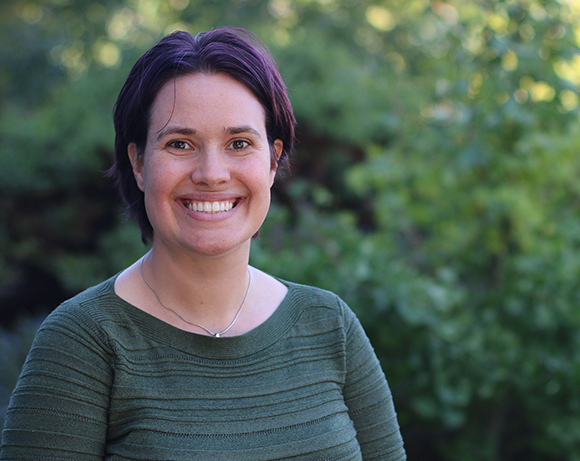
Assistant Professor Nicole Johnson-Glauch teaches in the Materials Engineering Department and also serves as Cal Poly’s General Engineering Program director, where she focuses on helping students succeed through inclusive teaching and community-building.
We spoke with Johnson-Glauch about her teaching and research in materials engineering, her passion for inclusive learning, and how she’s fostering community among students across both the MATE and General Engineering programs.
What is your hometown?
I was born and raised in Thornton, Colorado.
How long have you been teaching at Cal Poly?
I have been teaching at Cal Poly since 2019 as a lecturer in the Materials Engineering Department. It was my first job after earning my Ph.D. from the University of Illinois.
Tell me about your research interests and why you are passionate about this topic.
A college education profoundly impacts the lives of our students and those they go on to help in their careers. In my research, I aim to make sure what we do at Cal Poly sets them up for success no matter what they want to do. Specifically, I study how professional development activities and authentic assessments in engineering courses can help increase graduation rates for students from different backgrounds.
What do you want others to know about your research?
I want others to know that a key part of my research is including people on the research team who are from the communities that my work is trying to help. There’s a phrase in the disability advocacy community: “Nothing about us, without us.” While I have many life experiences, I know I have much to learn when it comes to supporting students from different backgrounds. I want to help as many people as I can, and what better way than working with and learning from the very people my work is trying to support?
What are some of the upcoming projects or publications you’re working on?
I am part of a recent program called EPIC+SURP. College of Engineering students in this program serve as both EPIC counselors and SURP student researchers studying the effectiveness of the EPIC program. They both positively impact their community and develop professional skills valuable to industry and graduate school.
What is your favorite part of your job?
Oh, definitely the students. Their energy and excitement are infectious. They give me a lot of hope for our future. Also, sometimes they ask a question I don’t know the answer to, and then I get to spend an hour learning something new.
How do you encourage engineering students to make an impact on the community?
I incorporate empathy-building into my course assignments. For example, every homework assignment has one problem asking students to explain how people are impacted by products based on the concepts in the course. Then I ask students to propose a way to use what we learned in class to positively impact a different group of people.
How do you support the college’s commitment to justice, equity, diversity and inclusion?
I run community-building activities for materials engineering students. One of these events is a MATE Department book club. The books I choose are written by a diverse range of authors and the stories contain themes related to justice, equity, diversity and inclusion. We meet once a week with coffee, tea and snacks. Having that dedicated time really lets us develop the close relationships MATE is known for. Several students cited the book club as one reason why they feel more a part of the department. Books we have read include “Babel” by R.F. Kuang, “Chip War” by Chris Miller and “A Memory Called Empire” by Arkady Martine.