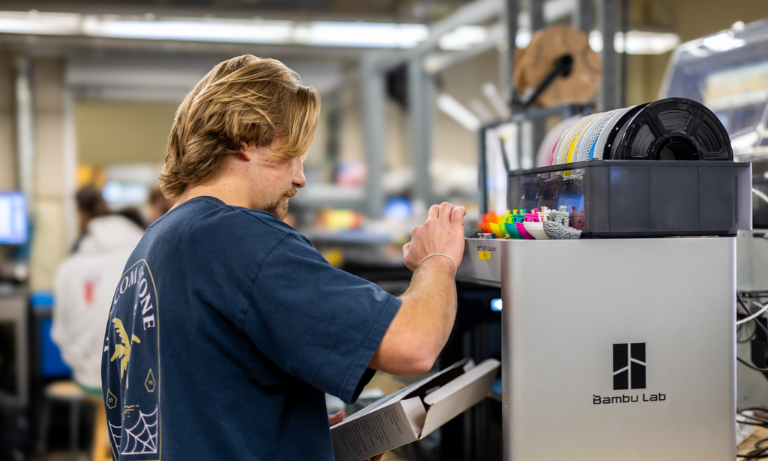

When Madeline Everson first stepped into the Cal Poly machine shop, she knew certification wouldn’t come easy. With the bones in her left hand fused together, she faced every task with one hand, drawing on the perseverance that earned her a degree in materials engineering in 2024 and now drives her pursuit of a master’s in biomedical engineering.
Her persistence was evident as she tackled drills, saws and sheet metal tools under the guidance of Cameron Yartz, a mechanical engineering student who graduated in 2025 and worked as a shop technician.
“It was scary, but Cameron really helped me through the process,” Everson recalled.
Everson grew up in Healdsburg, California, and was a patient at Shriners Children’s Hospital until age 18. Though doctors never determined the cause of her condition, prosthetics enabled her to stay active in sports and fitness. That resilience carried into her Cal Poly experience, including the challenge of earning her machine shop certification.
Not long after, her classmates took that same spirit of resolve as inspiration. In their senior year, Yartz teamed up with Emma Caringella, who earned her biomedical engineering degree in 2024, and Dawn Veditz, who completed her mechanical engineering degree in 2024 and stayed on to pursue a master’s in the same field. Together, they set out to design a new prosthetic device for Everson, whose previous prosthesis had failed, leaving her unable to lift more than a few pounds and sidelining her from one of her favorite activities: weightlifting.
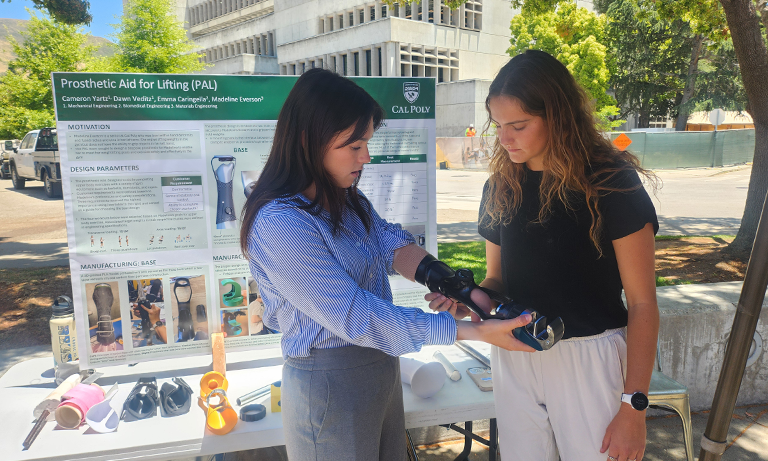
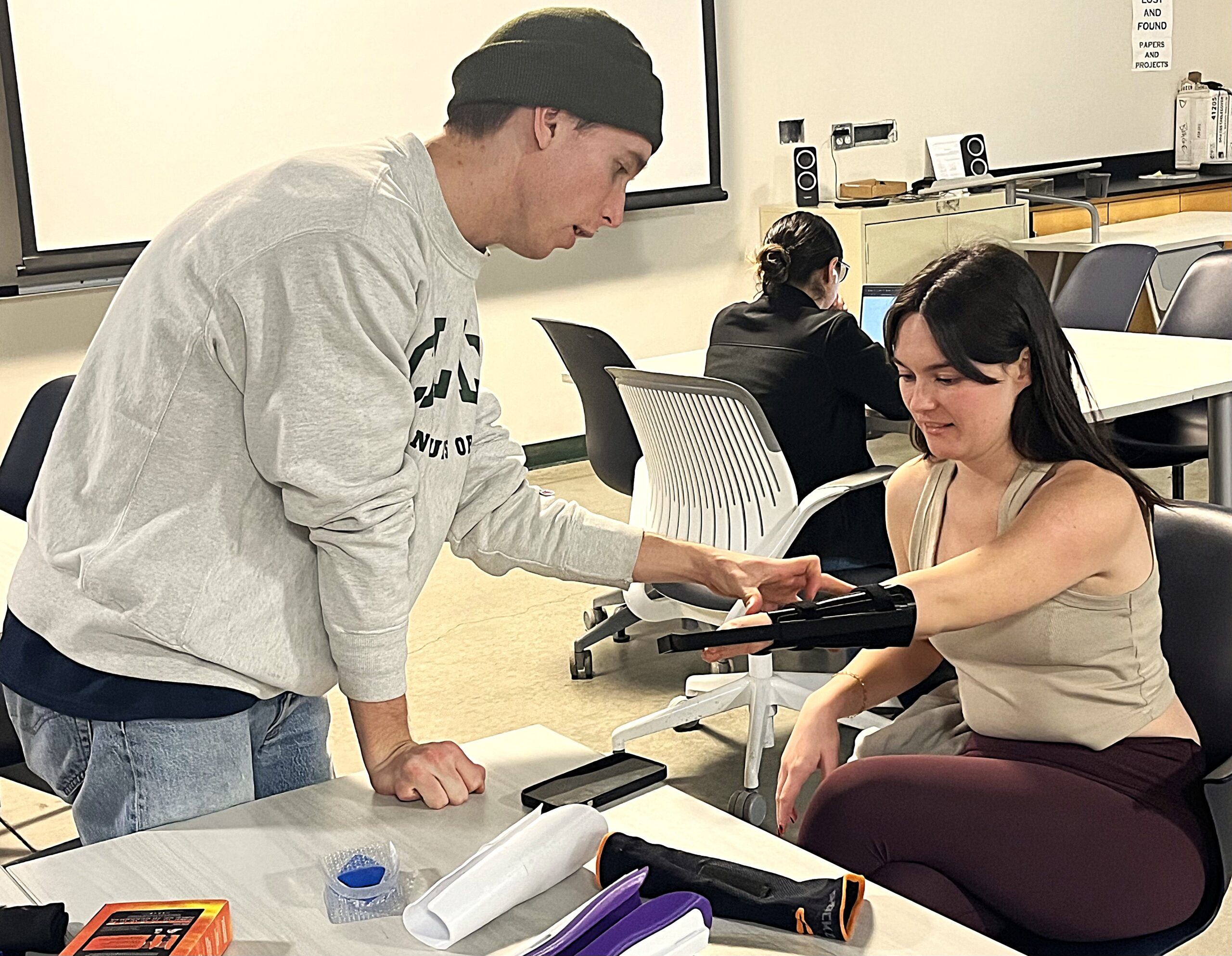
Working out of the TECHE Lab — a space dedicated to improving the quality of life for people with disabilities — the students developed the Prosthetic Aid for Lifting (PAL). The lab provided access to 3D printers, shop tools and an environment that encouraged creative approaches to accessibility challenges. Their design combined a semi-flexible shell with a neoprene sleeve and tightening mechanism, replacing Everson’s old Pro Cuff prosthesis with something far more effective and comfortable.
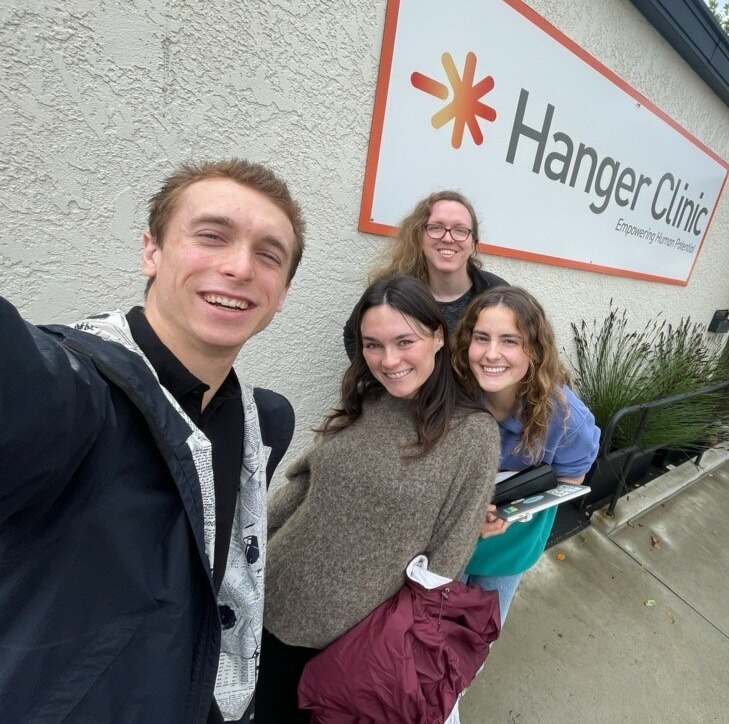
Throughout the process, Everson joined the team at the lab bench, testing prototypes and sharing feedback. Although she was leading her own senior project, she became an unofficial fourth member of the PAL team, lending her materials engineering expertise.
“Having a sponsor who understands the design process is as helpful for us as it is for Maddie,” Yartz said.
For Caringella, the project offered her first opportunity to work directly with a patient. “This project is unique because we receive direct feedback from our sponsor, who is also our peer and a fellow engineering student,” she said.
Veditz, whose interest in prosthetics has guided her into graduate study, said the experience expanded her perspective. “We conducted research on existing solutions, explored different attachments and engaged in extensive brainstorming,” she said. “I’ve also gained valuable insights into biology, which will be incredibly beneficial.”
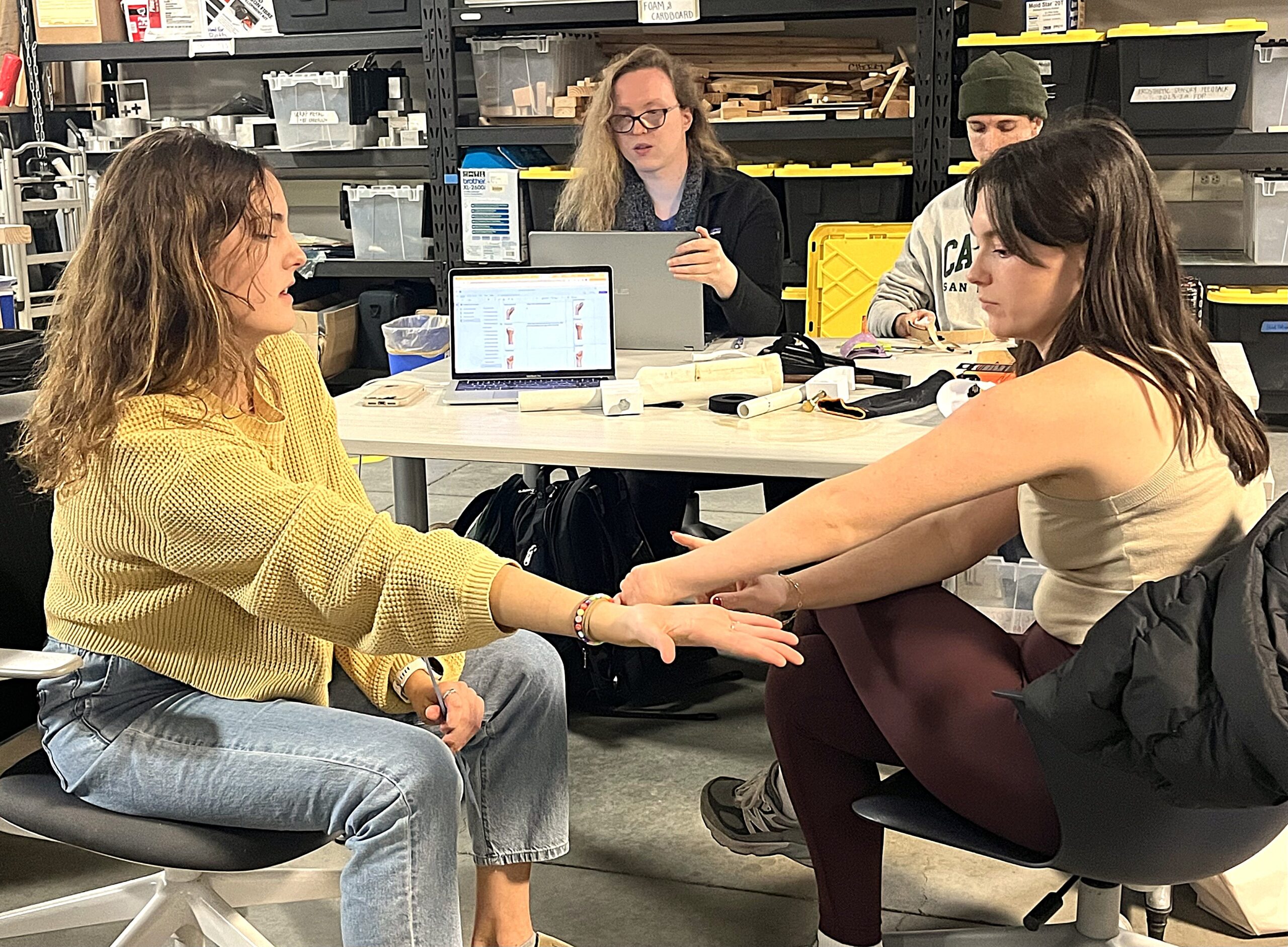
The team refined the device around specific gym exercises Everson wanted to do again, including bent-over rows, triceps pushdowns, lat pulldowns and bicep curls. Along the way, they tested materials and brainstormed new attachments.
At the Engineering Project Expo, the team unveiled PAL, with Everson demonstrating its capabilities in front of faculty, students and visitors. The moment was especially meaningful for her: “I couldn’t imagine a better group for this task,” she said. “It’s incredible to see so many people eager for me to succeed.”
The project underscored the power of collaboration among peers, giving Everson both a prototype and the experience of seeing classmates rally behind her goals. As she continues her biomedical engineering master’s at Cal Poly, she carries forward the same resolve that shaped the team’s work.
By Emily Slater