Kathryn Tinney laughed as she remembered her first look at the hydropower prototype built by Cal Poly’s previous competition team.
“I thought, ‘How am I going to pull this off?’” she said.
Tinney had never worked with hydropower before. Her teammates were learning, too. The four mechanical engineering majors had stepped into a senior project that required them to consider site selection and how a turbine could fit into an existing water system.
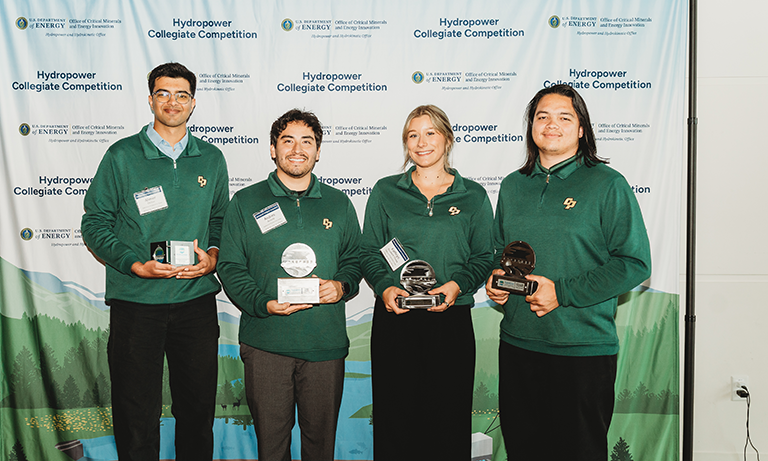
By the end of the year, that uncertainty had turned into a working hydropower model and a national title for Cal Poly students Andres Arreola, Ahmer Dhillon, Sammy Taporco and Tinney.
The students won first place overall in the U.S. Department of Energy’s 2026 Hydropower Collegiate Competition, which challenges student teams to develop hydropower solutions for industry needs. Cal Poly also took first in the Build and Test Challenge and the Community Connections Challenge.

The first-place finish marked Cal Poly’s highest placement yet in the competition, following a second-place finish last year and third place in 2024. The university has also been selected to return in 2027, giving another group the chance to build on that momentum.
Mechanical engineering lecturer Lauren Rueda, the team’s faculty adviser, said hydropower pushed the students past turbine design and into questions of infrastructure, permitting and community impact. Because all four students were mechanical engineering majors, that broader scope added another layer to the challenge.
“That can be hard for a hydropower project,” Rueda said.
Taporco said the competition drew on civil engineering concepts, while Arreola said the environmental and permitting side brought a steep learning curve. The team had to determine where a turbine could realistically be installed and whether the design could function in the field.
The DOE competition offered several tracks. Cal Poly chose in-conduit hydropower, which captures energy from moving water inside existing systems. After weighing several approaches, the team focused on a pressure reduction station in Sacramento.
A visit with a local wastewater treatment plant operator helped the students see the practical side of their work. Tinney said the tour raised questions that could not be answered by calculations alone, including how installation could be timed without affecting water flow to residents.
As they narrowed their design, the students researched turbine types and evaluated which options could work at the Sacramento site. They also drew on resources from Jigger Jumonville, a part-time lecturer in the Mechanical Engineering Department with turbomachinery expertise.

The team eventually designed a Banki cross-flow water turbine, a lower-cost option that could make the system easier to scale. Building and machining the model on campus gave the students more control over the final design and helped set Cal Poly apart, Rueda said.
“Most schools don’t have that capability,” she said.
Tinney said the team worked with an industry mentor, a 2015 Cal Poly graduate now working in hydropower, to bring the test stand closer to industry standards. In competition feedback, reviewers praised the professional build and clear test plan.
The students kept revising until the deadline.
“We kept going back to the drawing board, as in, this is not good enough,” Taporco said. “We were critical of our decisions and designs.”
That same mindset shaped the team’s outreach.
Community connections counted for a significant portion of the score, and Cal Poly’s team made the category one of its strengths. Members visited New Tech High School in Nipomo, where they taught a turbomachinery lesson to 82 students over two days.
The lesson tied directly to material students were already studying, Rueda said. Cal Poly students also helped the high schoolers build their own turbines and compete against one another, giving them a direct look at the engineering behind hydropower.
The outreach stood out in competition feedback, with reviewers highlighting the high school lesson and surveys used to measure student learning. Taporco said Cal Poly’s classroom effort was unique among the competing teams.
At the national competition’s final event in Green Bay, Wisconsin, held alongside the National Hydropower Association’s Midwest Regional Meeting, the team presented its work to judges and industry attendees through formal presentations and quick pitches. Dhillon described the experience as hectic, with presentations each day and late nights spent preparing for the next round.
“We met people across the industry,” Tinney said.
Cal Poly brought one of the smallest teams to the competition, Rueda said, but the students’ preparation and chemistry stood out. Taporco said the group laughed often, even under pressure, and knew they were working toward the same goal.
“Team chemistry helps,” he said. “We knew we were in this together to get through it.”
The competition is designed to prepare students for an industry facing a workforce shortage. The DOE has noted that nearly 20% of the American hydropower workforce is approaching retirement, opening the door for young professionals who understand the field’s technical and practical demands.
By the end of the project, some team members could see a future in the industry. Tinney will be working at Diablo Canyon, Arreola said he is actively looking for jobs in hydropower, and Dhillon said the experience deepened his interest in the field.
Cal Poly’s project began with a 70-page rulebook and a subject the students were still learning. Month by month, they turned that challenge into a hydropower model they could test and defend.
“We all had the same mindset,” Tinney said. “Giving 100% effort.”
By Emily Slater