
Code With a Human Connection
At Cal Poly’s DXHub, Gus Flusser used AWS technology to help public agencies tackle time-consuming problems and found the kind of work he wants to pursue
Gus Flusser had demonstrated software to clients before. He had never seen one jump out of a chair.
The reaction came after he and another Cal Poly student showed a school district a tool designed to turn footage from public board sessions into a structured draft of the minutes.
“It was the first and only time I’ve seen a customer jump out of their seat for joy,” Flusser said.
The moment stayed with him. By then, Flusser had spent years learning how to build software, but the staff member’s response showed him that a well-designed tool could solve problems people had simply learned to live with and, in this case, give district staff hours of their time back.
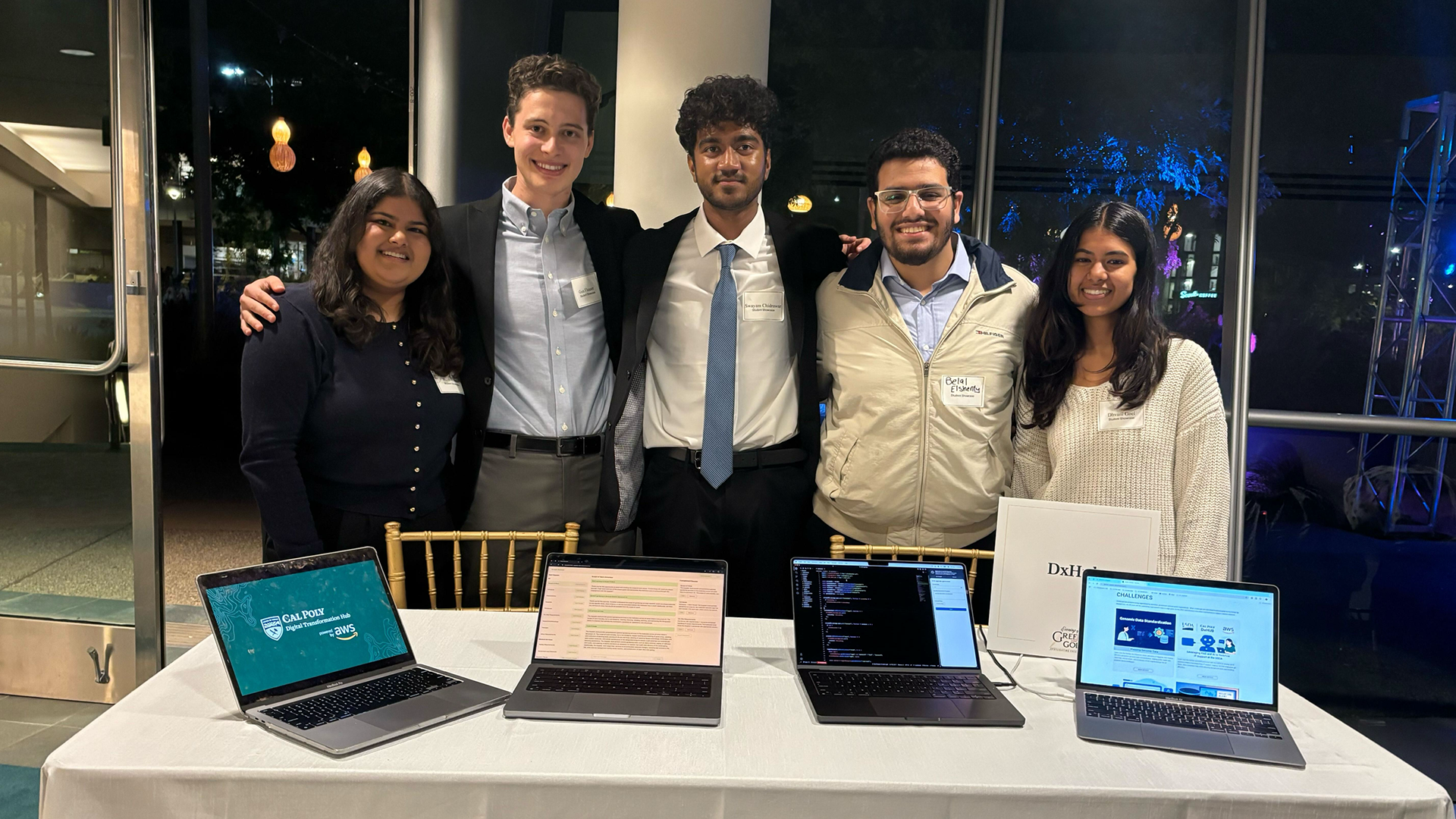
As a computer engineering student with Cal Poly’s Digital Transformation Hub, Flusser developed several tools for public-sector and nonprofit organizations. The DXHub partners with those groups to understand complex problems and explore possible solutions. There, Flusser used Amazon Web Services and other technologies to turn their needs into testable prototypes that could be deployed and, when complete, shared more widely.
Together, those projects gave Flusser a clearer sense of the kind of work he wanted to pursue after graduation: technology shaped by the needs of the people who would use it.
• • •
Two years after arriving at Cal Poly from Palos Verdes in Southern California, Flusser entered the DXHub’s 2024 Digital Transformathon with little sense of what the organization did. The draw was the sizable cash prize attached to the two-day competition, which tasked students with developing a project that could benefit the city of San Luis Obispo.
Flusser joined a team and helped create the winning solution.
“I thought, ‘Cool. Cash prize,’” he said. He had no reason to expect the competition would come to define the rest of his Cal Poly experience, inside and outside the classroom.
Months later, however, a connection he made through the hackathon opened a path to the DXHub. As Flusser searched for a summer internship after his second year, he contacted a San Luis Obispo city employee he had met during the competition. The employee passed his information along to the DXHub, which hired Flusser as a student developer in June 2024.
His first assignment focused on procurement, a field familiar to him through his father’s work. Guided by DXHub staff, Flusser learned to apply AWS technology through the organization’s Working Backwards process, which begins with the customer’s needs.
The assignment required more than functional software. Flusser met with customers and refined the system around their feedback.
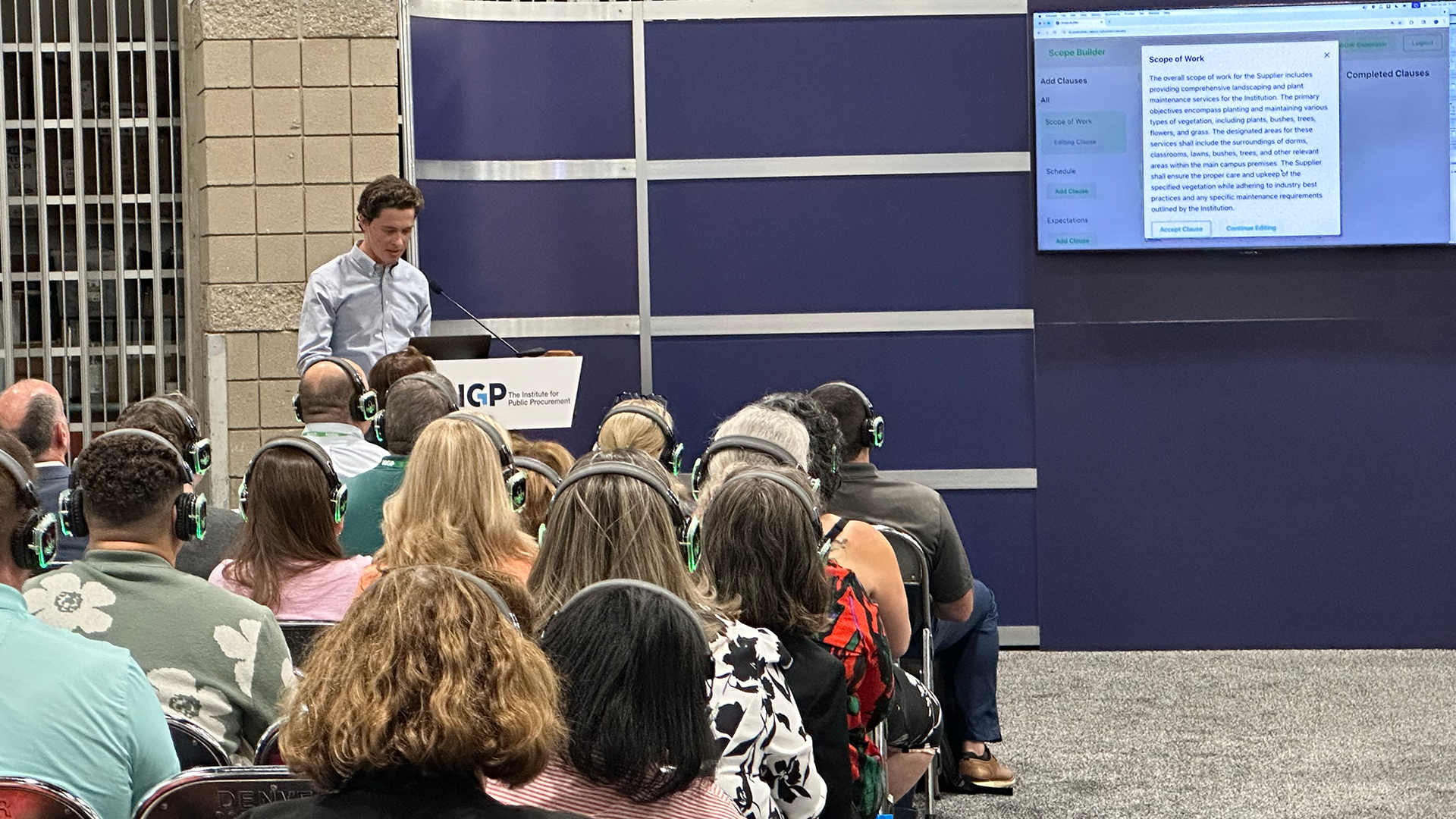
In January 2025, Flusser presented the procurement solution at the Auxiliary Organizations Association Annual Conference in San Diego. Less than a year after entering the hackathon, Flusser was sharing the DXHub’s work with a broader audience.
• • •
That joy-filled jump during a demonstration for Lynwood Unified School District offered Flusser a more personal measure of the technology’s impact.
Producing meeting minutes could consume three workdays for one employee, while colleagues took on other parts of the secretary’s workload. Much of that time went toward reviewing the footage and sorting the discussion by agenda item.
Flusser and another student developer recognized that a basic transcript would not solve the problem. District staff needed a draft that already followed the agenda and could be adjusted before it was finalized.
The students mapped the workflow on a whiteboard, then selected the AWS services that could support each step. Their system, called Minute Maker, paired the meeting recording with its agenda to transcribe the discussion and organize it under the corresponding items for staff review.
“We added a lot of features that really impressed our customer,” Flusser said, including auto translation and links to exact timestamps in the meeting video.
The project soon departed from the DXHub’s typical model. After developing a prototype, the DXHub generally turns it over to the customer, which provides the computing resources needed to deploy and operate it. Minute Maker, however, drew interest beyond Lynwood.
“We knew this solution had potential beyond Lynwood, so we hosted a demo version that other agencies could try out,” Flusser said. “That’s something we rarely do.”
San Diego County later began operating the system in its own environment, showing how a prototype built for one school district could scale to another public agency.
• • •
Another DXHub assignment was less straightforward: helping public agencies make large PDF collections usable by people with disabilities without updating files one by one.
The work has taken on greater urgency as larger state and local government entities prepare to meet new federal online accessibility standards by April 2027.
“These cities and counties have hundreds of thousands of documents,” Flusser said.
Making a PDF accessible can require establishing the order in which text should be read and adding descriptions for images, yet files vary widely from page to page. A college course catalog, for example, might combine images with text arranged in different orientations, complicating efforts to extract and organize the content.
Flusser first tried treating each page as an image for an artificial intelligence model, but the results fell short. He then turned to Amazon Textract, an AWS service that could identify text and its position on the page.
Textract provided only part of what he needed. Flusser developed a parsing algorithm to organize the extracted information and worked through requirements such as document tags and alternative text. He also searched for a validation tool that could test multiple files efficiently.
“There were twists and turns, but I had lots of little victories along the way,” he said.
Together, those small wins have helped move the tool closer to production, offering public agencies a way to confront a task too large to tackle one document at a time.
• • •
As graduation approached, Flusser took on another DXHub assignment that reinforced the importance of building technology around the people it is meant to serve.
Riverside County wanted to make it easier for residents to locate and claim money owed to them. The county maintains searchable records of unclaimed funds, but residents may need to navigate separate databases and provide documentation to validate a claim.
Flusser joined a team developing a tool designed to bring the process into one place and simplify it for residents.
That focus on the people behind the problem shaped his time at the DXHub, giving him a form of Learn by Doing that extended beyond the classroom.
“DXHub has single-handedly been the most formative experience I’ve had at Cal Poly,” he said. “Seeing the whole process helps you find out what you love about a system.”
Seeing each stage up close also clarified what Flusser wants from his next opportunity.
“I want to stay involved with the customer side of the work,” he said. “I don’t want to lose that human connection.”


