
When the Plasma Finally Stayed Lit
A STEM-NET-supported research project helped students revive a hand-sized plasma thruster while exploring a potential solution for air-breathing electric propulsion
The glow stayed on.
After spending the summer trying to coax a hand-sized plasma thruster back to life, Cal Poly aerospace engineering student Eddy Tapia and his friends watched as the device finally did something different.
It kept working.
Earlier tests had failed once the students introduced propellant. This time, the plasma continued glowing inside the vacuum chamber. The minutes stretched on until the thruster had run for a full hour, giving the students the sustained test they had been working toward for months.
“We were jumping for joy,” Tapia said.
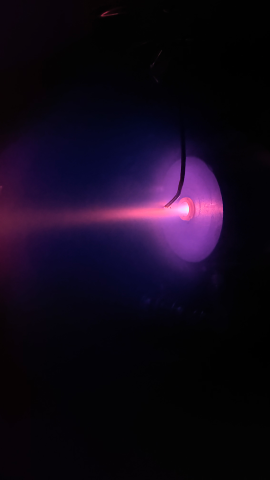
Tapia, a fourth-year aerospace engineering student, is soft-spoken, but his face brightened as he pulled up a video of the glowing plasma and described the moment the project finally came together.
The breakthrough followed a summer research project supported by Cal Poly’s Summer Undergraduate Research Program and the California State University’s STEM-NET, which connects students and faculty across the CSU through research and other STEM initiatives.
Tapia’s project explores a problem tied to air-breathing electric propulsion, an emerging approach that could allow satellites flying in very low Earth orbit to use traces of the atmosphere as propellant.
At those low altitudes, atmospheric drag becomes significant, requiring spacecraft to continually generate thrust to remain in orbit. Researchers are studying whether satellites could collect atmospheric gases and use them for propulsion, reducing the amount of propellant they need to carry.
But there is a catch.
Many electric propulsion systems rely on an electron source called a hollow cathode, which is not well suited to operating with air. That means even an air-breathing system may need to carry argon or xenon just to operate the cathode.
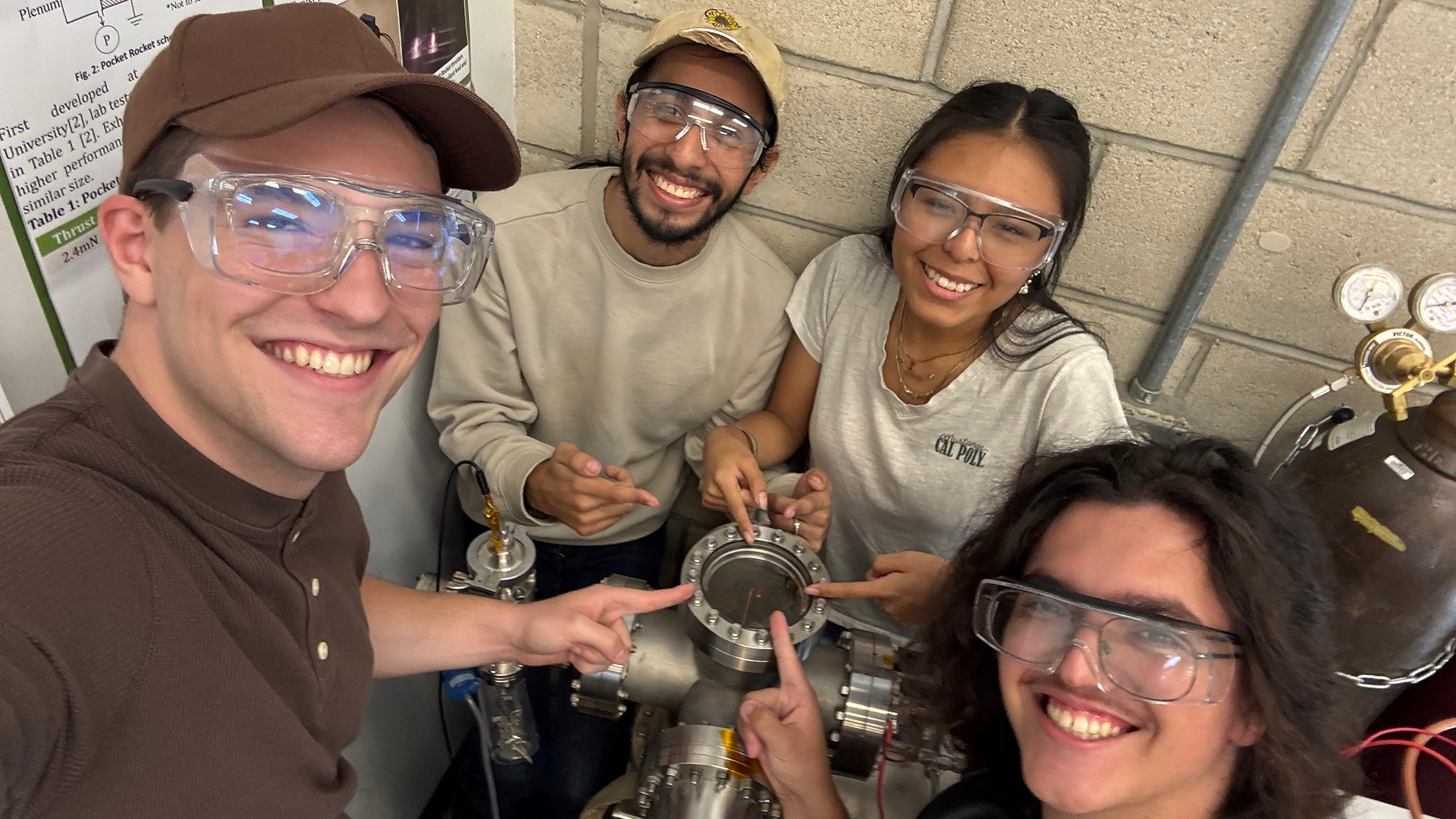
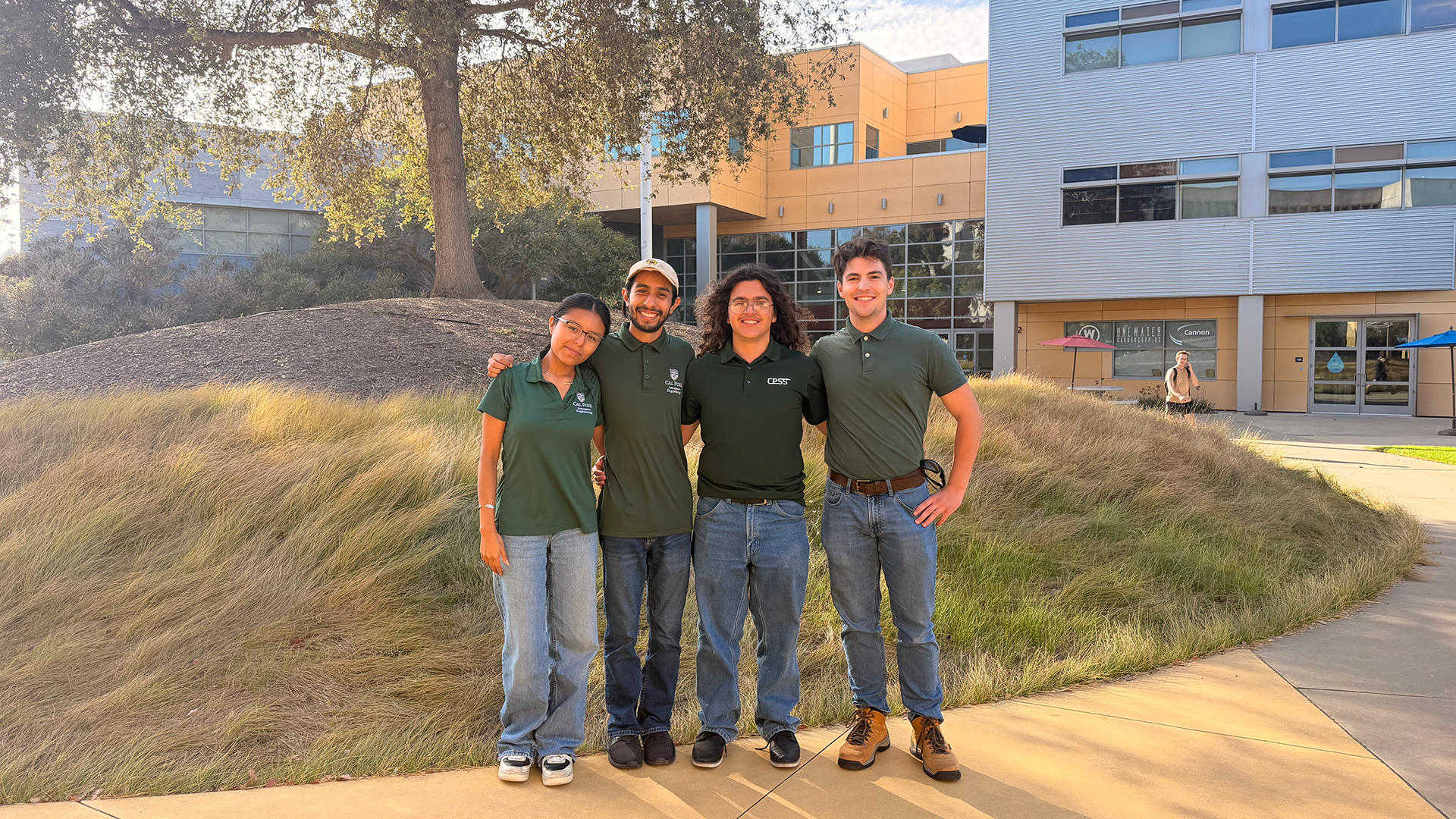
Tapia recruited three friends, all fellow fourth-year aerospace engineering students: Ivana Condori Franco, Juan Lopez Godina and Tristin Koury. Together, they investigated whether Pocket Rocket, a plasma device previously researched at Cal Poly under former aerospace engineering professor Amelia Greig, could eventually offer an alternative that is compatible with air.
Tapia’s interest in plasma grew from a class he took with aerospace engineering professor Lubos Brieda, whose enthusiasm helped draw Tapia into the field. Brieda leads the Poly Plasma Research Group, where students work directly with him on research involving plasma and electric propulsion.
“He loves his plasma,” Tapia said.
That enthusiasm proved contagious. Tapia became fascinated by plasma and by the possibility of using electric propulsion rather than a traditional chemical burn in space.
During the summer, the group tested Pocket Rocket and studied its plasma.
Much of their work happened inside a small vacuum chamber nicknamed “Baby,” which had largely sat unused for years. Creating the near-perfect seal needed for testing became one of the group’s biggest challenges. They ran the system so much that they eventually burned out a wire, which now hangs on the wall as a reminder of the summer.
The students tested Pocket Rocket using argon gas while working to understand its performance and see how the design might eventually be adapted for air-breathing propulsion. Their summer ended without the sustained result they wanted.
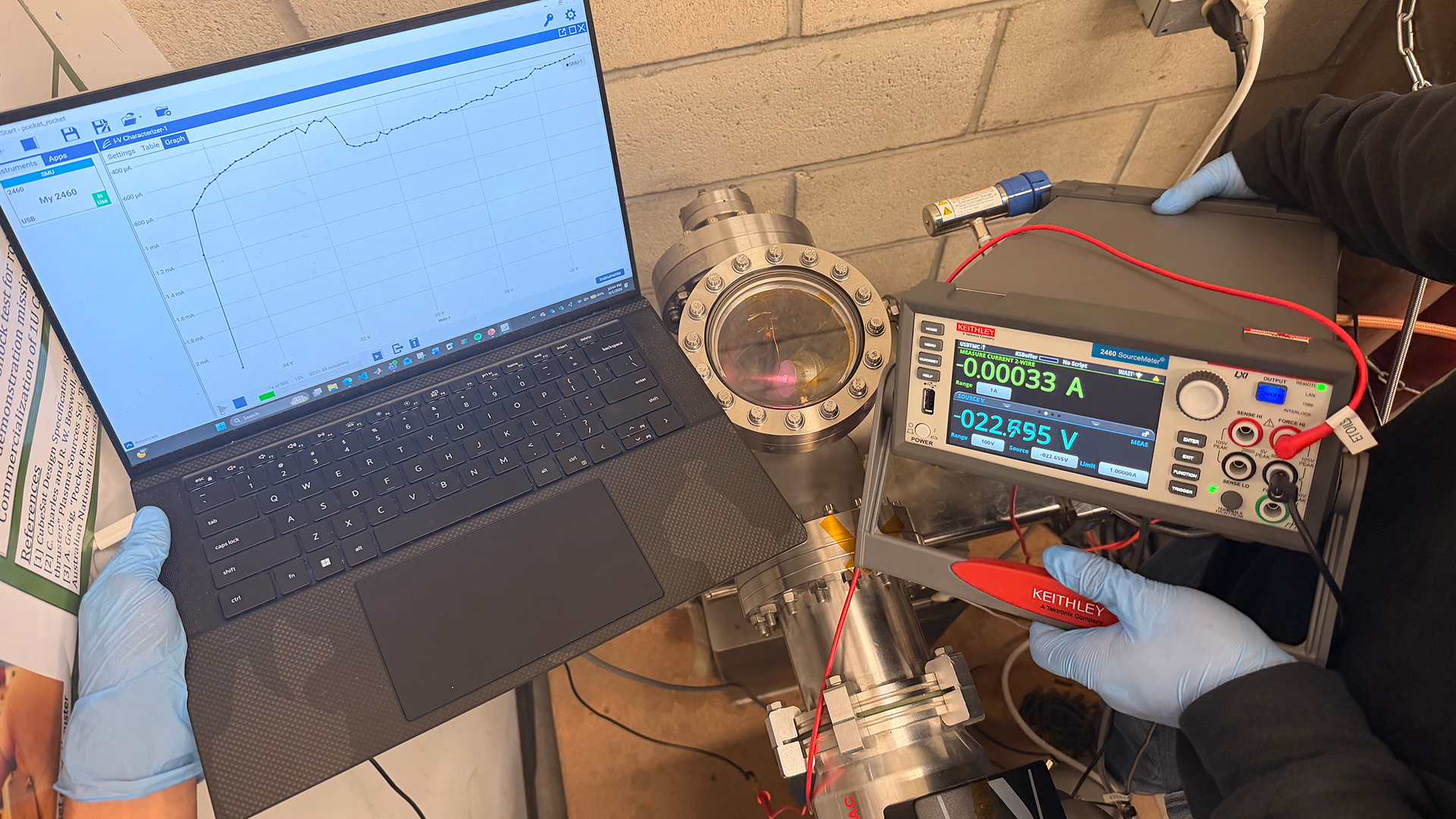
Then, during the first week of the new semester, the plasma stayed lit.
Tapia recently presented the research at STEM-NET’s 2026 Virtual Symposium, sharing a project that had taken him from months of troubleshooting to an hourlong test that showed Pocket Rocket could reliably produce plasma.
The next step is to develop a new design that could increase Pocket Rocket’s emission current. Brieda said the longer-term goal is to determine whether the device could eventually serve as a cathode compatible with air.
That work lies ahead. But for Tapia and his friends, getting Pocket Rocket to run reliably was already a breakthrough.
2026 SURP+ Symposium Coming Up
This year’s student researchers will share work completed during summer 2026 at Cal Poly’s annual SURP+ Research Poster Symposium from 11 a.m. to 1 p.m. Friday, Oct. 16, at Engineering Plaza. The event gives the campus community an opportunity to meet student researchers and learn about projects conducted across Cal Poly’s summer research programs.
Support applied research opportunities for Cal Poly students by giving to the Summer Undergraduate Research Program Fund, which helps students work alongside faculty researchers and put classroom knowledge into practice.
Learn More About the Poly Plasma Research Group
Explore the group’s research and student opportunities at polyprg.org.


