
Wei’s Research Brings Human Behavior Into Healthcare Planning

Student publication and NSF grant advance work recognized with a College of Engineering scholar award
Distance to a healthcare facility does not always determine whether someone will use it.
That distinction is central to research led by Zhiyuan Wei, an assistant professor of industrial and manufacturing engineering who uses data and optimization models to examine how people access essential services. His recent work with industrial engineering student Daniel Hopkins found that pharmacy choices are influenced by the characteristics of surrounding communities as well as geographic proximity.
Hopkins and Wei published their findings in Risk Analysis, the flagship journal of the Society for Risk Analysis. Their article, “Modeling Human Mobility Behaviors in Healthcare Access: Integrating Spatial and Social Dimensions,” examines pharmacy visits in Los Angeles County.
The researchers combined large-scale mobile phone mobility and pharmacy visitation data with demographic information to examine how people choose where to seek care. Using discrete choice theory, they developed a multinomial logit model to predict pharmacy visit behavior. The model outperformed a comparison machine-learning model and showed that people are more likely to visit pharmacies in communities with socioeconomic characteristics similar to those of their home neighborhoods.

The research offers a broader way to understand healthcare access. Traditional planning approaches often focus on whether a facility is nearby, but Wei’s work considers how people use the services available to them and what may influence those choices.
Wei will continue that work through a National Science Foundation Engineering Research Initiation grant for the project “Optimizing Healthcare Accessibility by Integrating Human Mobility Behaviors into Facility Planning.” The project will incorporate mobility patterns and individual choice behavior into optimization models intended to support more equitable and effective decisions about healthcare access planning.
The project, scheduled to run from 2026 through 2028, will also give students opportunities to contribute to research involving data analytics, mathematical modeling and healthcare optimization.
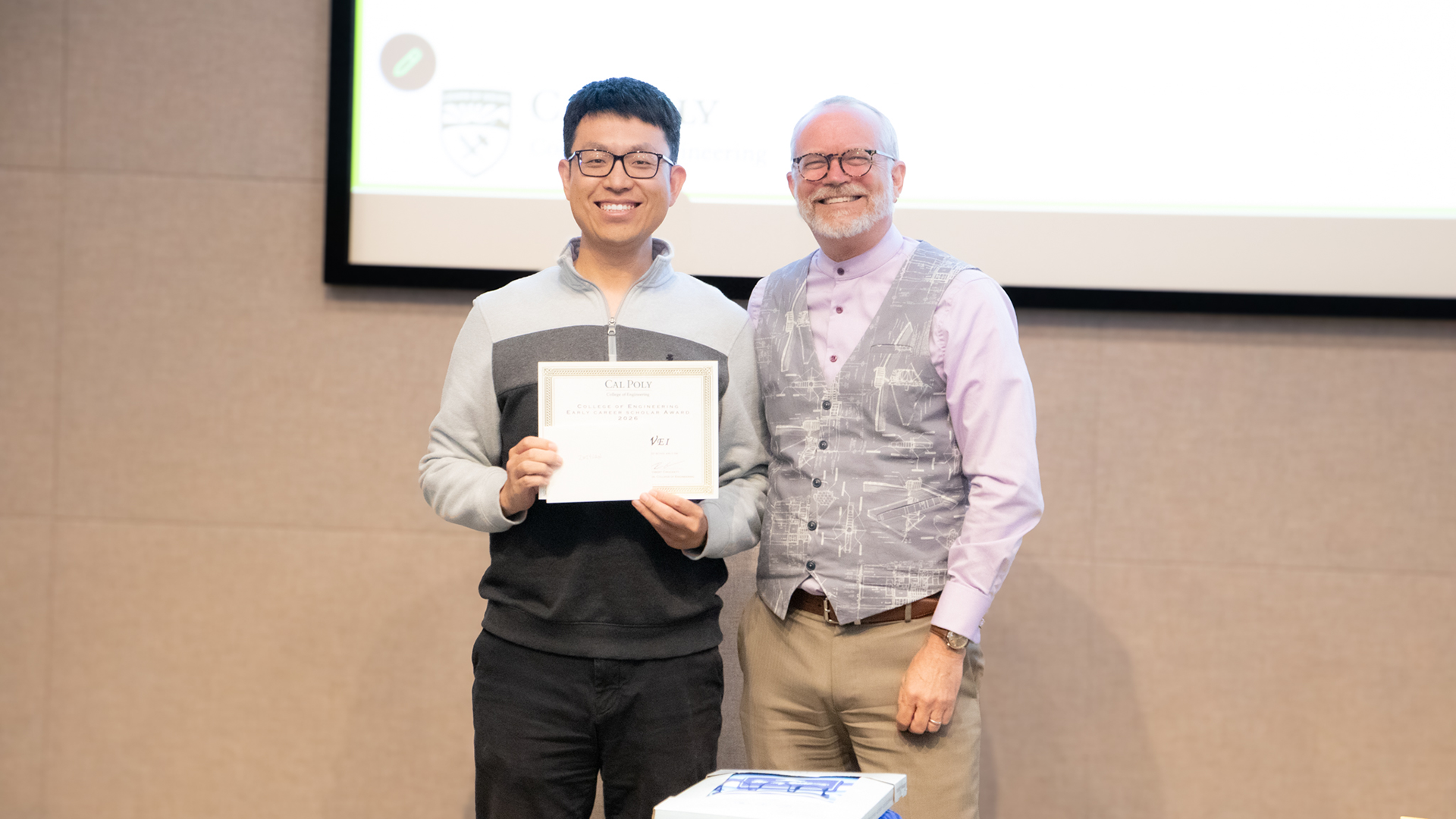
Wei’s research was recognized with the College of Engineering Early Career Scholar Award, which honors an early-career faculty member whose scholarly achievements have received external validation.
The publication and NSF-supported project reflect his broader focus on using industrial engineering and optimization tools to understand human behavior and improve public systems. His work could help planners create healthcare networks that are both accessible and better aligned with how communities seek care.
Help IME students share their research at national and international conferences by supporting the Research Experience Fund, which helps remove travel costs that can stand between students and career-building opportunities.


