
Building a Radio Lifeline Across 3 Counties, One Mountaintop at a Time

Cal Poly students help expand an independent communications network from Monterey to Santa Barbara to support emergency response
A message can now travel from Monterey to Santa Barbara without relying on commercial internet service. A chain of radio links carries the message between sites on hills and mountaintops across the region.
Cal Poly students helped make that connection possible.
On Oct. 3, the Cal Poly Amateur Radio Club and its community partners completed a yearslong effort to extend the Amateur Radio Emergency Data Network (AREDN) across Monterey, San Luis Obispo and Santa Barbara counties.
Beyond transmitting messages across three counties, the network supports email and voice calls between connected locations. With adequate backup power, it could provide emergency volunteers with a means of exchanging critical information when wildfires, earthquakes or other disasters disrupt conventional communications.
“We are capable of operating emergency communications when everything else fails,” said AJ Gregory, an electrical engineering graduate student who served as the club’s president last year.
Building the Connection
Building a high-tech communications network sometimes requires surprisingly low-tech work.
At the Clark Valley site in San Luis Obispo County, club president Akshay Sathish, a fourth-year computer engineering student, has done everything from wiring Ethernet cables to clearing brush. He first visited about three years ago, when a prefabricated vault housed the site’s electronics, and has returned repeatedly as the facility evolved.
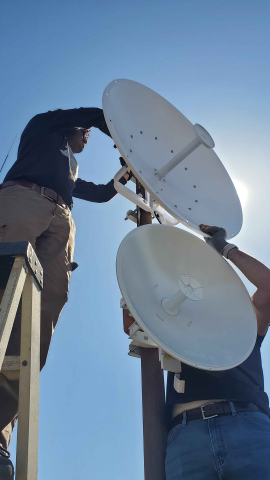
Expanding the network meant upgrading aging equipment at sites spread across the region. In May 2025, the club secured a $77,000 grant from Amateur Radio Digital Communications to modernize the system and extend its connections. The project was already underway, but the pace picked up when the funds became available in early 2026.
All 13 main radio sites involved in the project have since received improvements, either through equipment purchased with grant funding or physical upgrades carried out by Cal Poly club members and local amateur radio volunteers, Sathish said.
But money alone couldn’t overcome the obstacles involved in reaching the sites.
Many locations are on privately owned mountaintops, where landowners control access and may need to be present during installations. Organizing a workday means coordinating those visits while arranging transportation for students and equipment to the remote sites.
“It’s always an access problem,” said Gregory, who helped lead the project during his presidency.
Once crews arrive, a different challenge begins. At Williams Hill, crews used computer-aided design to plan a six-panel solar array before installing it on an equipment vault. At Ranchita Canyon, volunteers erected a new antenna tower and installed solar power equipment.
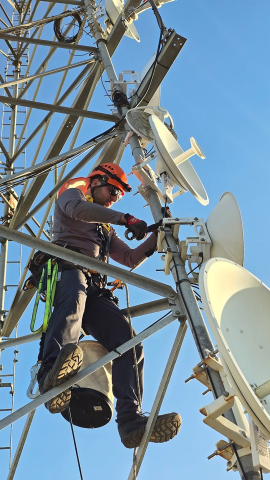
Some work takes place high on communications towers, requiring specialized expertise. Cal Poly alumni Davide Lanfranconi and Marcel Stieber, both experienced tower climbers, are among the volunteers contributing to the project.
Students have taken responsibility for much of the planning and installation effort, meeting weekly to coordinate work and devoting weekends to sites throughout the region.
Those challenges have shown Gregory the difference between designing an ideal system and making it function under actual conditions.
“You get to see optimal vs. realistically optimal,” he said.
The club helped spark Gregory’s interest in radio frequency engineering, now the focus of his master’s research. Sathish said working alongside predominantly electrical engineering students has felt almost like pursuing a second major.
Gregory estimates that 20 to 30 students have contributed to the project alongside alumni and amateur radio volunteers, collectively devoting thousands of hours to the network.
“It was a community effort,” he said.
Making the Connection Last
After years of installations and coordination across the region, the students tested the expanded network with a voice call.
During a club meeting, members placed the call and monitored the sites carrying the transmission. As the call went through, Sathish remembered the reaction:
“It actually works!”
The test offered a tangible payoff for work that had progressed one installation at a time. Sites such as Clark Valley, where Sathish had spent years helping improve the equipment, were now part of a system reaching far beyond San Luis Obispo County.
Licensed amateur radio operators can use compatible equipment to access the network and exchange email and voice calls. The Cal Poly club also participates in county emergency communications exercises and is testing check-ins through AREDN’s Meshphone system.
With the three-county link in place, the club is turning its attention to making the network more reliable. Some sites still need equipment upgrades or backup power systems, while additional radio links would allow data to travel along alternate routes if one fails. Gregory described that ability as “self-healing,” a capability the team hopes to strengthen through the next phase of improvements.
The club is also working with other amateur radio groups to extend the network north toward the Bay Area and south toward Los Angeles, building on the progress already made along the Central Coast.
Upgrades to the existing sites are expected to continue for at least another year. Both Sathish and Gregory hope to remain involved after graduation, following the example of alumni who have continued contributing to the project.
As the network’s reach grows, so does its potential to help people communicate when they need it most.
To learn more about the Cal Poly Amateur Radio Club and its activities, visit w6bhz.org. To support student clubs like CPARC, consider a gift to the CENG Student Activities Fund.
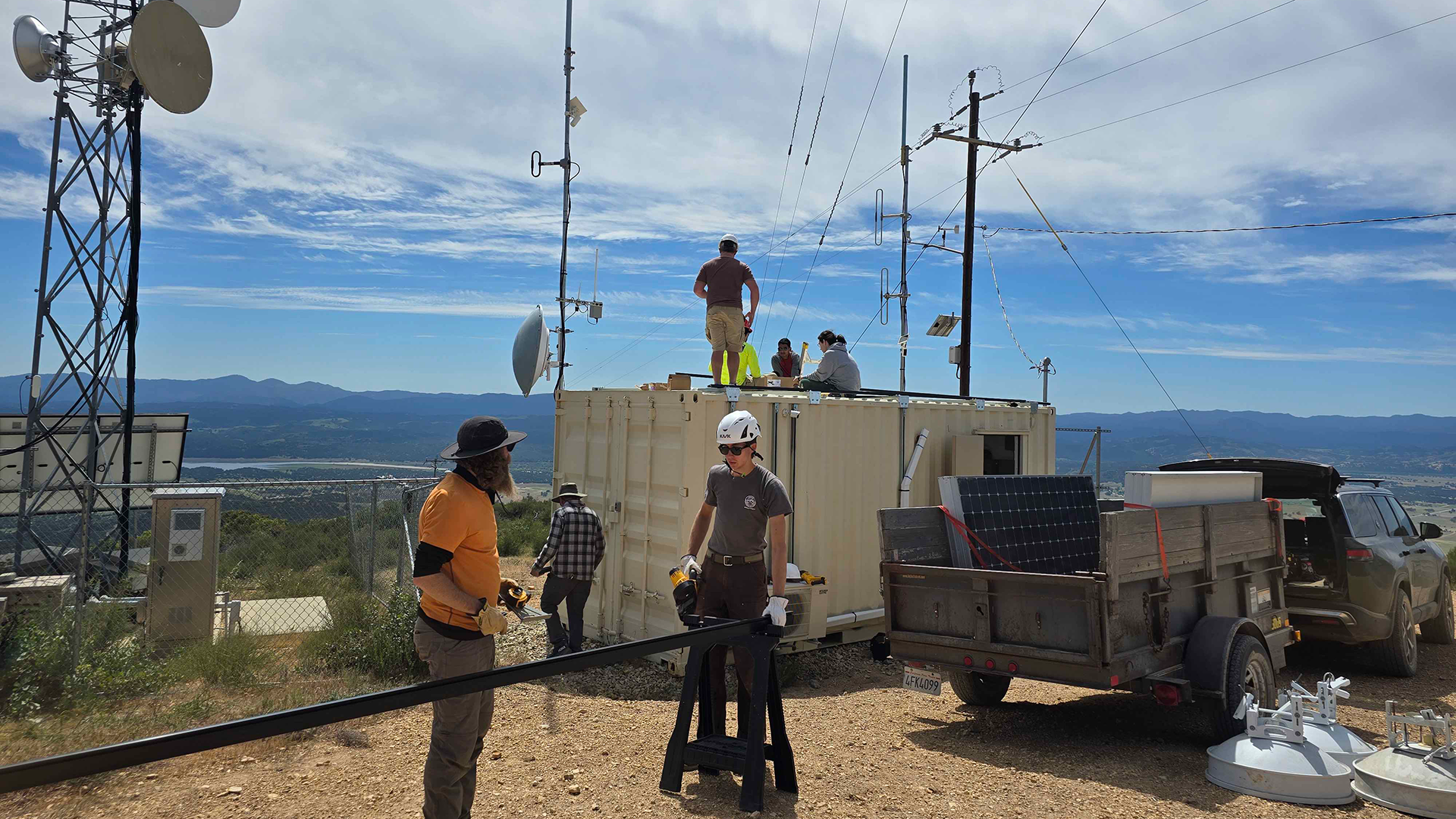
Top photo: Members of the Cal Poly Amateur Radio Club and community volunteers gather at the Orcutt Hill West communications site, where work on radio infrastructure helped expand the Central Coast’s emergency communications network.


