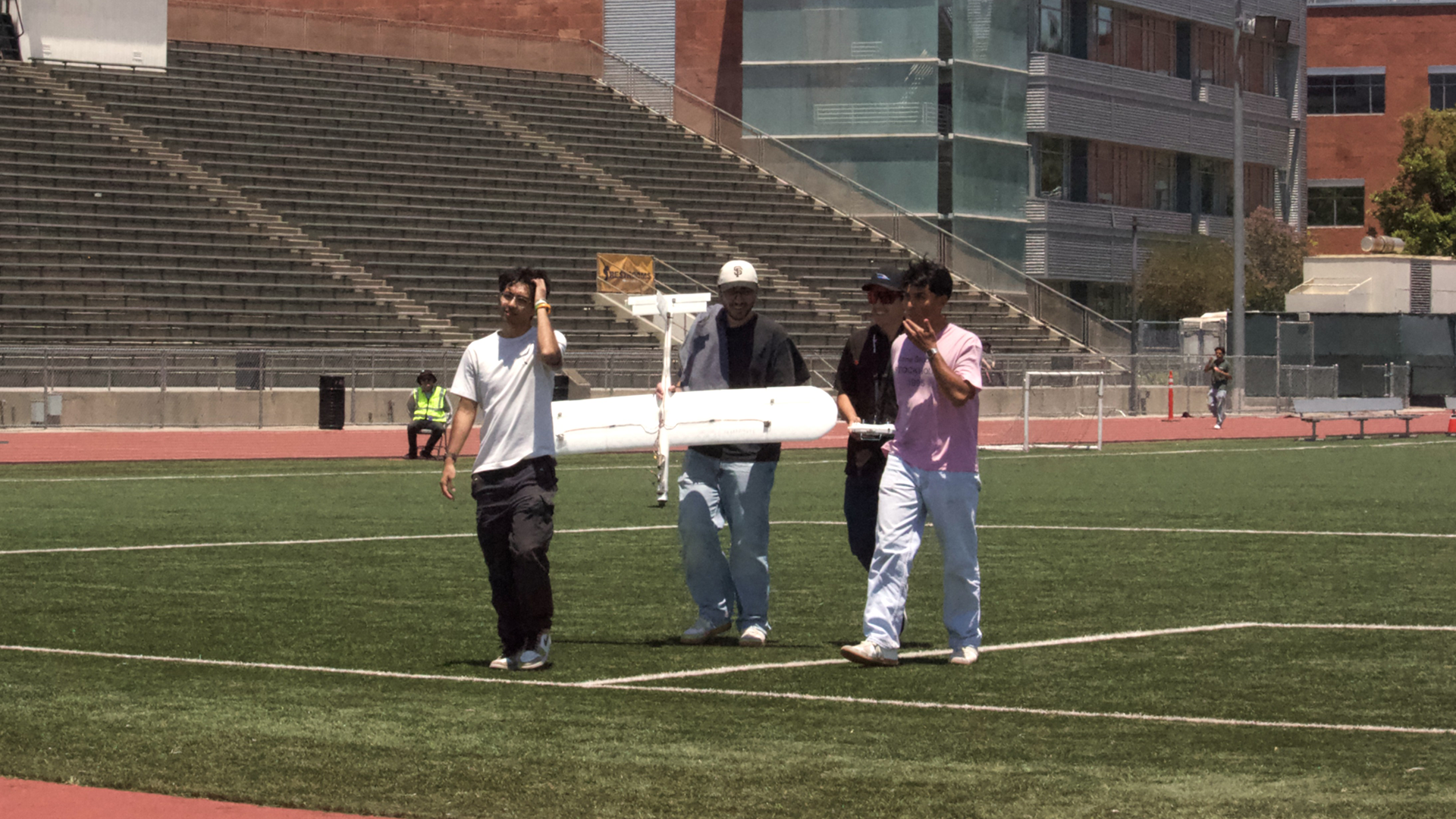
Filament Flyers Soar to First in 3D-Printed Aircraft Competition

Mechanical engineering senior project team overcomes an early design setback to claim the top flight award at Cal State LA
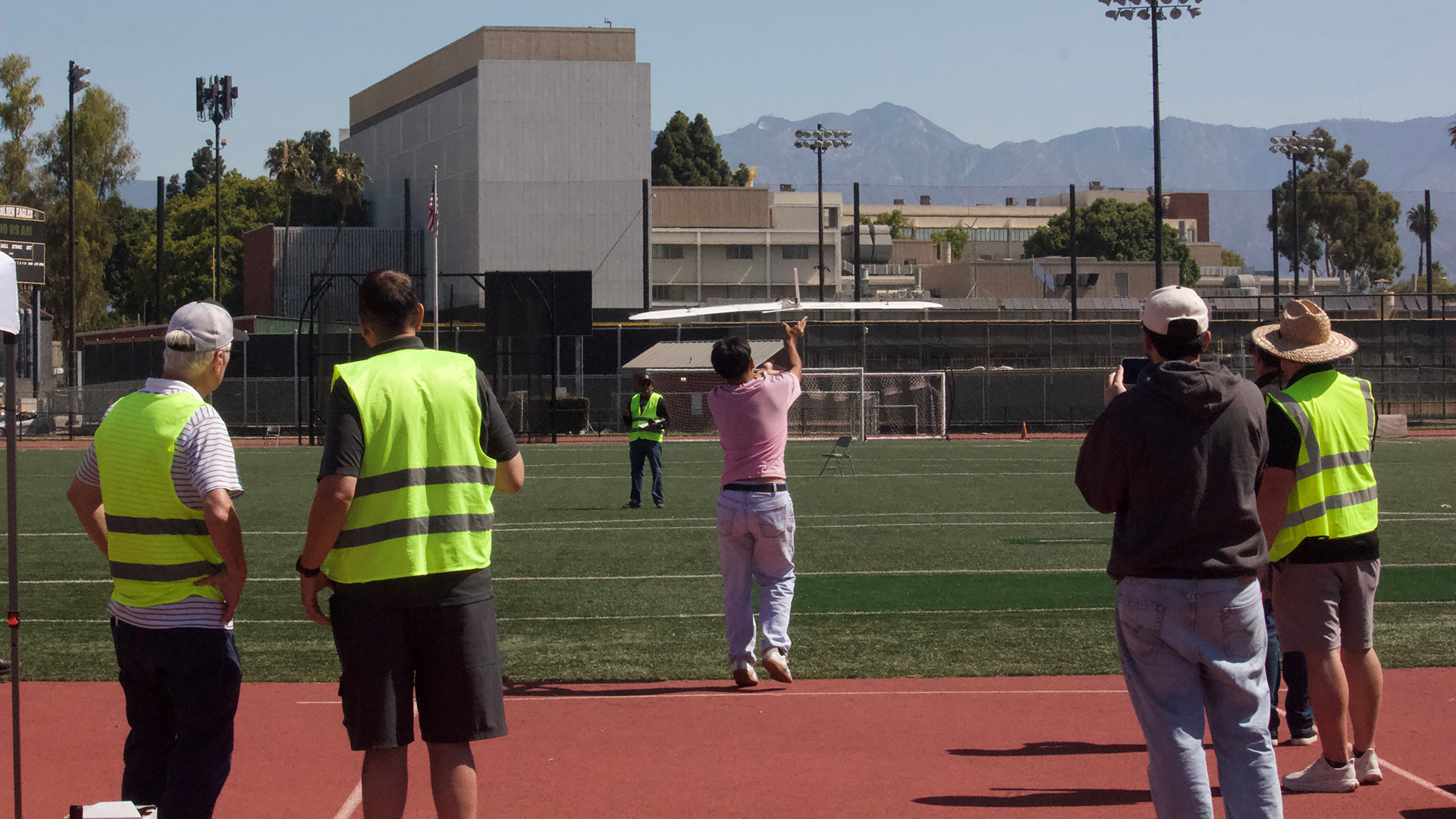
Seconds after Israel Villegas launched the Filament Flyers’ 3D-printed aircraft at Cal State LA, the flight appeared headed for a quick end.
“It looked like we were going to hit the ground,” said mechanical engineering student Armando Ramirez.
Instead, Isaias Cabral pushed the throttle to full power, sending the aircraft up to the competition’s 35-foot height limit before maneuvering it within the field boundaries and sending it into a glide.
“It came down, floating just above the ground for what felt like an eternity before it finally touched down safely,” Ramirez said.
That 30.84-second flight, including the eight seconds of motor power allowed under competition rules, ultimately earned Filament Flyers first place in the flight competition at the fourth annual CSU 3D-Printed Fixed-Wing Aircraft Competition on May 30.
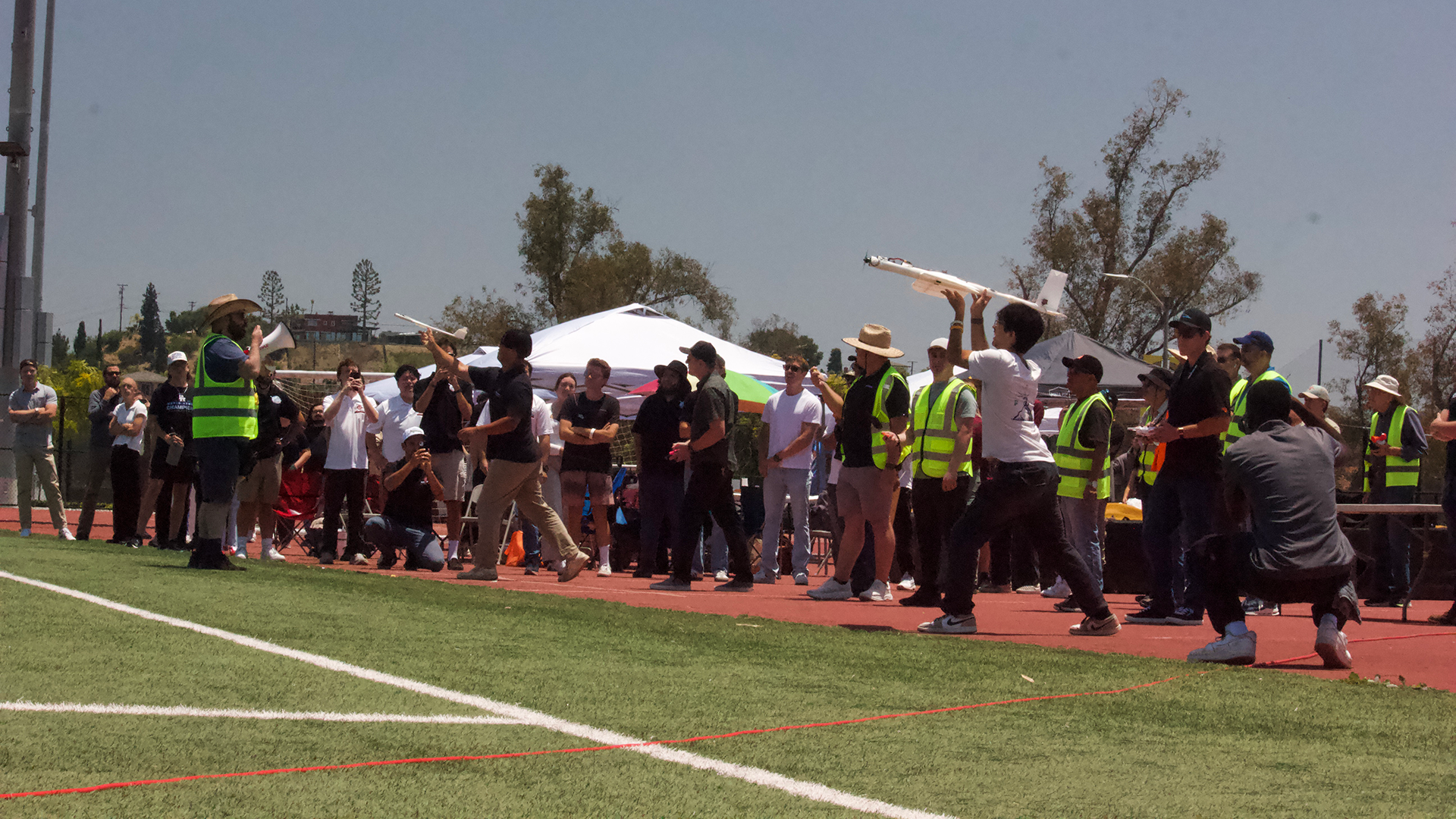
The Cal Poly mechanical engineering senior project team included Cabral, Ramirez, Villegas and Arda Yilmaz, with mechanical engineering professor Eltahry Elghandour serving as adviser. Their challenge was to design and test a fully 3D-printed aircraft capable of staying aloft as long as possible after its brief powered climb.
Getting to that winning flight required a major change in direction.
The team spent months pursuing a flying-wing aircraft that eliminated a traditional tail and fuselage to reduce drag and weight. But flight testing exposed a problem.
“We stuck with the flying-wing design until about halfway through winter quarter,” Ramirez said. “During testing, the aircraft had basically no yaw authority since it had no tail or vertical stabilizers.”
The students considered adding a stabilizer, but with only a few months remaining before the competition, they decided a conventional glider offered a more reliable path forward.
The deciding moment came when they reviewed video of one of their test flights.
“It just fell out of the sky,” Ramirez said.
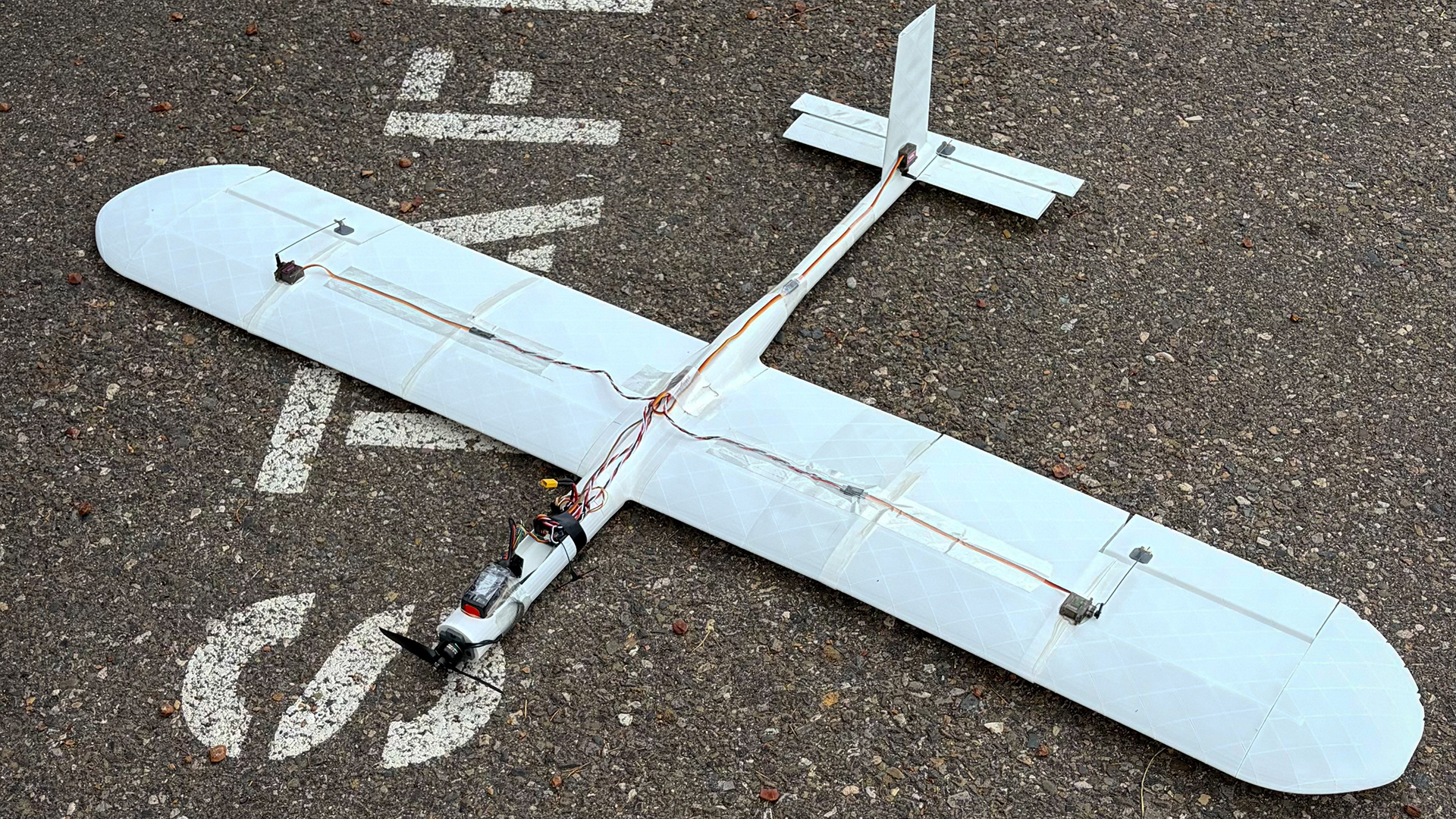
The team redesigned the aircraft around a conventional glider configuration with a high-aspect-ratio wing and tail. The final plane, manufactured primarily from lightweight PLA filament, had a 1.65-meter wingspan and used a flight controller to help stabilize it during its powered climb and glide.
The redesign did not end the troubleshooting.
One of the biggest challenges was determining the aircraft’s center of gravity and tuning its flight controller. Because the printing process created a hollow structure, the finished plane did not perfectly match the team’s CAD model.
“We spent a lot of time tuning the flight controller so it wouldn’t overcorrect, and moving the battery around to shift the center of gravity into a favorable position for competition,” Ramirez said.
Test flights also showed the plane pitching and struggling to bank properly. The students adjusted the flight controls until it became more stable.
Ramirez focused primarily on material selection and structural analysis, researching lightweight materials strong enough to withstand flight and landing forces and testing how the aircraft’s structure would hold up under load.
By competition day, the team had hoped to arrive with multiple completed aircraft in case one was damaged. Instead, they brought one assembled plane and a backup plan.
“We ended up showing up to competition with one fully assembled plane and a bin of spare parts, ready to glue back together if we crashed,” Ramirez said.
Even after their 30.84-second flight, the students could not celebrate. San Diego State’s second attempt was just 0.6 seconds shorter.
A crosswind picked up before the third round, and both teams posted shorter flights. Only then did Filament Flyers know its second attempt had held up for the win.
For Ramirez, the experience differed sharply from a typical classroom assignment.
“In class, you rarely hit real roadblocks, since assignments are built for students to replicate work an instructor has already done,” Ramirez said. “Here, we were constantly navigating design changes, testing and calibration issues, and a tight deadline, with no instructor’s solution to fall back on.”