
Building What’s Next in Aerospace

New Cal Poly workshop prepares students and faculty to explore business opportunities tied to the growing space economy around Vandenberg
Bob Crockett’s return to the classroom reaches back to one of the earliest chapters of his engineering career.
In the 1980s, Crockett worked as a systems engineer on the design of the space station, considering how it could evolve to support future lunar missions. He later became a biomedical engineering professor at Cal Poly and spent two decades teaching students how to move medical technologies toward the marketplace.
Now, after serving as interim dean of Cal Poly’s College of Engineering, Crockett is bringing those experiences together in AERO 4470, a new aerospace entrepreneurship workshop offered in fall 2026.
“It’s a treat for me to come full circle,” said Crockett, who is entering the final chapter of his Cal Poly career.
The pilot course arrives as commercial launch activity and aerospace investment accelerate around Vandenberg Space Force Base. Part of the broader Space Vandenberg initiative, Vandenberg Innovates is aimed at channeling that momentum into innovation and entrepreneurship around the spaceport. Crockett sees Cal Poly students and faculty helping shape businesses that could take root there.
“This class is one piece of a much bigger puzzle,” Crockett said. “If you have a big space base, you have to build that workforce to support it. Small companies can serve as magnets for other industry.”
Creating New Paths in Aerospace
Space Vandenberg, led by regional economic development organization REACH, is supported by a $9.5 million California Jobs First award spread across multiple programs and organizations. Through Vandenberg Innovates, Cal Poly works with Vandenberg Space Force Base, industry and other partners to move ideas emerging from research and operational challenges toward commercial applications.
The effort includes student and faculty teams working on Space Force and industry challenges, along with programs that give promising concepts more time to develop. Crockett’s workshop focuses on the entrepreneurial side of that process, teaching participants how to evaluate potential ventures.
Crockett points to a strong local foundation, including successful aerospace companies started by Cal Poly students and alumni in areas such as drones and advanced manufacturing. He hopes the workshop can build on that track record by opening that path to more people.
“This is a whole new group of people we can expose entrepreneurship to,” Crockett said.
The workshop is designed to reach beyond students. Faculty members are invited to participate, and Crockett is exploring ways for Vandenberg personnel and other community members to take part through Cal Poly Extended, Professional and Continuing Education.
The workshop’s structure also reflects a model Crockett knows well. He is adapting a biomedical entrepreneurship course he taught for years, noting similarities between two industries that often push against the boundaries of what is technically possible. Both rely heavily on hardware and are highly regulated, with failures that can carry serious consequences.
Despite those complexities, participants can come in with curiosity rather than an invention or startup concept.
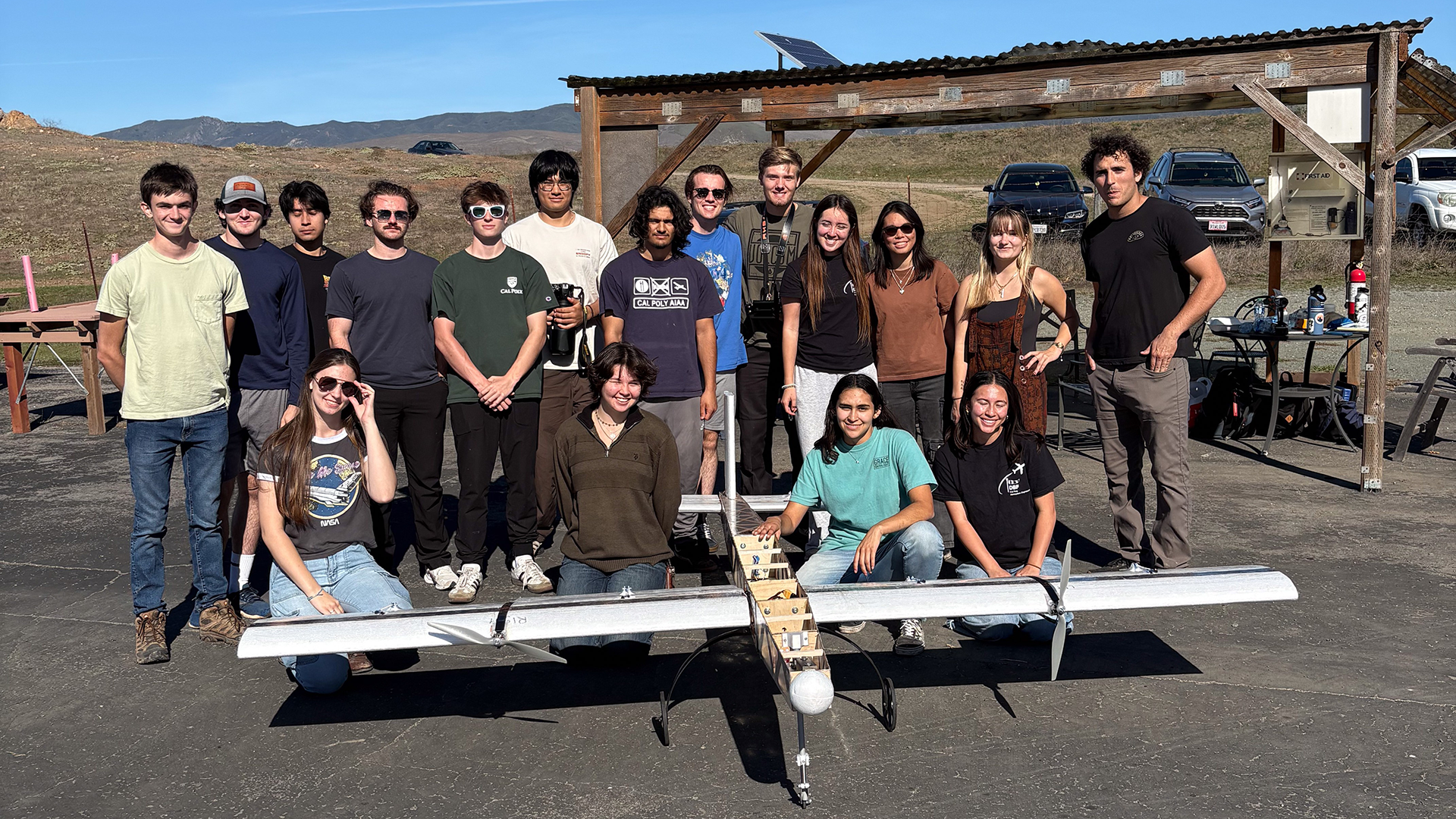
Aerospace engineering student Allegra Ciarlantini, who will take the course this fall, became interested in entrepreneurship after a summer internship with a small aerospace company. She was drawn to the project-based format and the possibility of continuing to develop an idea with seed funding after the course, calling it “a wonderful way to learn more.”
That willingness to explore is what Crockett hopes to encourage.
“Entrepreneurship can be intimidating, and aerospace entrepreneurship can be even more intimidating,” he said. The starting point, though, is simple. “You need to find a need and match it with a product.”
Participants will form teams and begin by interviewing people in the aerospace industry. They will use those conversations to narrow a broad set of possibilities to one concept, then assess its market potential, business model, intellectual property and regulatory requirements.
“Someone might have a great idea, but will that make a good business?” Crockett said.
Crockett will help teams answer that question throughout the course, bringing in entrepreneurs and other specialists while participants evaluate one another’s ideas and offer candid feedback.
Teams interested in continuing afterward will have access to funding through the initiative to further develop promising ideas with the Cal Poly Center for Innovation & Entrepreneurship.
Taking the Long View
“My goal at the end of this is not to have a bunch of successful companies in 15 weeks,” Crockett said. The value, he said, is in giving participants a chance to practice the entrepreneurial process now and gain experience they can draw on later.
“Two, three or 10 years from now, that idea might come to fruition,” he said.
Even without launching a startup, participants may leave better able to spot and evaluate promising opportunities, whether they join an established aerospace company or later pursue a venture of their own.
Crockett has seen that long view pay off in biomedical entrepreneurship, where former students have gone on to develop medical technologies and launch companies. He hopes the aerospace workshop can give a new group the confidence to pursue ideas of their own.
Decades after considering how the space station might support future missions, Crockett is asking students and faculty to look closer to home. As the aerospace economy expands around them, what will it require next, and who will be ready to respond?
Crockett hopes the workshop will give participants the experience to recognize where they can contribute and the tools to act when the time is right.
Interested in the Workshop?
Faculty members interested in participating, or anyone with questions about AERO 4470, can contact Bob Crockett at rcrocket@calpoly.edu.


