
Students Push Cal Poly’s Thermal Vacuum Chamber Through Its Longest Cycle

Late one night last summer, lights still burned in the Space Propulsion Facility at Cal Poly’s Advanced Technology Laboratories. Students kept watch over the thermal vacuum chamber, tracking its readouts and checking liquid nitrogen levels as the test pushed past midnight.
Keeping the chamber stable for 24 hours required overnight monitoring. The run was the longest continuous test the system had ever sustained at the university.
“It stretched us a lot,” said Kira Abercromby, an aerospace engineering professor who helped lead the effort. “We had to run it in shifts, and it was great training for the students.”
Thermal vacuum testing removes air and cycles temperatures to mimic orbit conditions and see how hardware responds. Abercromby compares that stress to an iPhone that overheats and shuts off — a familiar reminder that electronics have limits when temperatures swing.
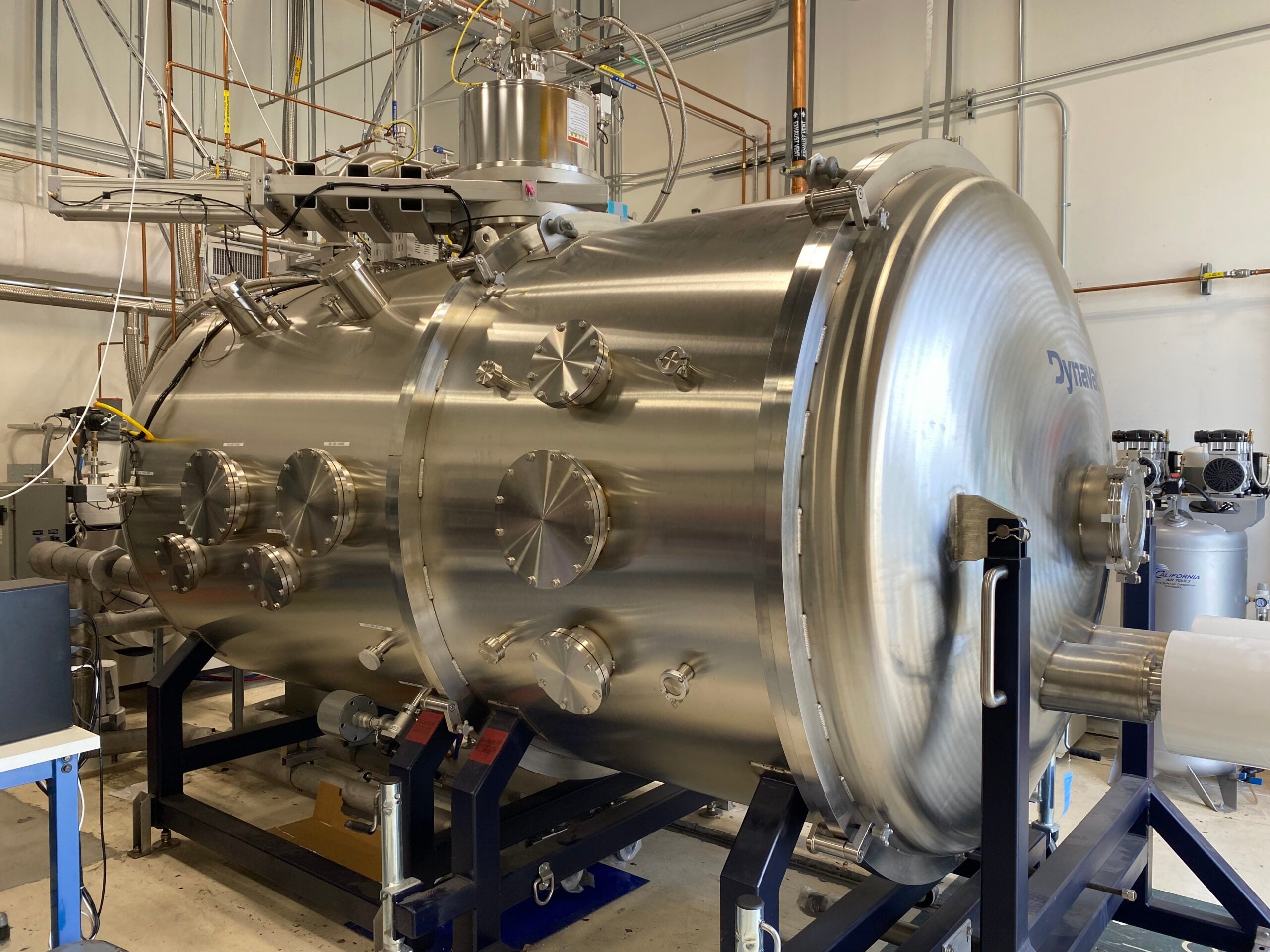
Installed and commissioned in 2022, the chamber began early testing in fall 2023 as students and faculty ran shorter cycles to develop procedures and confidence before stepping up to long-duration testing last summer.
The work is part of a larger push to make the chamber a dependable resource for student training and future customers. Purchased through Cal Poly’s partnership with the Air Force Research Laboratory, it was part of a roughly $2.5 million effort tied to aerospace engineering and workforce training. The 24-hour run was designed to move it closer to regular use.
Building the Playbook
Emily Lieber is used to planning around a schedule. A fourth-year aerospace engineering student and a Cal Poly soccer player, she couldn’t step away for a traditional internship. The Summer Undergraduate Research Program kept her in San Luis Obispo and gave her a way to build on what she’d already learned about vacuum chambers in the Space Environments Lab.
Before the first long test, the team met a few times to walk through the facility and get comfortable with the system. When Lieber first saw the chamber up close, she said, the reaction was immediate.
“Ahhh,” Lieber said, throwing her arms wide. “It was so shiny, nice and new. In a league of its own.”
The team didn’t jump straight to a 24-hour test. Lieber described the project as a step-by-step ramp-up designed to understand what the chamber could handle and what it would take to operate it for long-term, sustainable use. Early runs focused on shorter heating and cooling tests, then longer cycles that added “soaks,” holding at a set temperature long enough to reach a stable plateau.
Not every run behaved perfectly. Lieber said the team was highly accurate on cooling tests, but heat runs put them into troubleshooting mode.
“Things don’t always go 100%,” she said.
As the tests lengthened, the rhythm of the lab changed. Lieber said students recorded data every 30 minutes during one extended run, with overlapping shifts to avoid gaps in collection and a worksheet tracking what to watch. Between check-ins, the team played Settlers of Catan, and by the end of the project, she said, she’d become a veteran player.
“There was a lot of time to get to know everyone,” Lieber said. “TVAC is a great culture.”
As the team grew more familiar with the chamber, they named it STELLA, short for Space Testing Environment Laboratory Low-Pressure Assessment. Lieber said the naming process stretched over weeks, with a running list on an iPad and plenty of debate about which “buzz words” mattered most before the group narrowed it to a few finalists.
“You grow affectionate with the chamber,” she said. “It almost feels like a person because of all the quality time we spend with it.”
That affection didn’t replace discipline. Abercromby said the work required a process mindset that mirrors industry. “This is a good system, and it requires procedures,” she said. “That’s how it works in industry, too.”
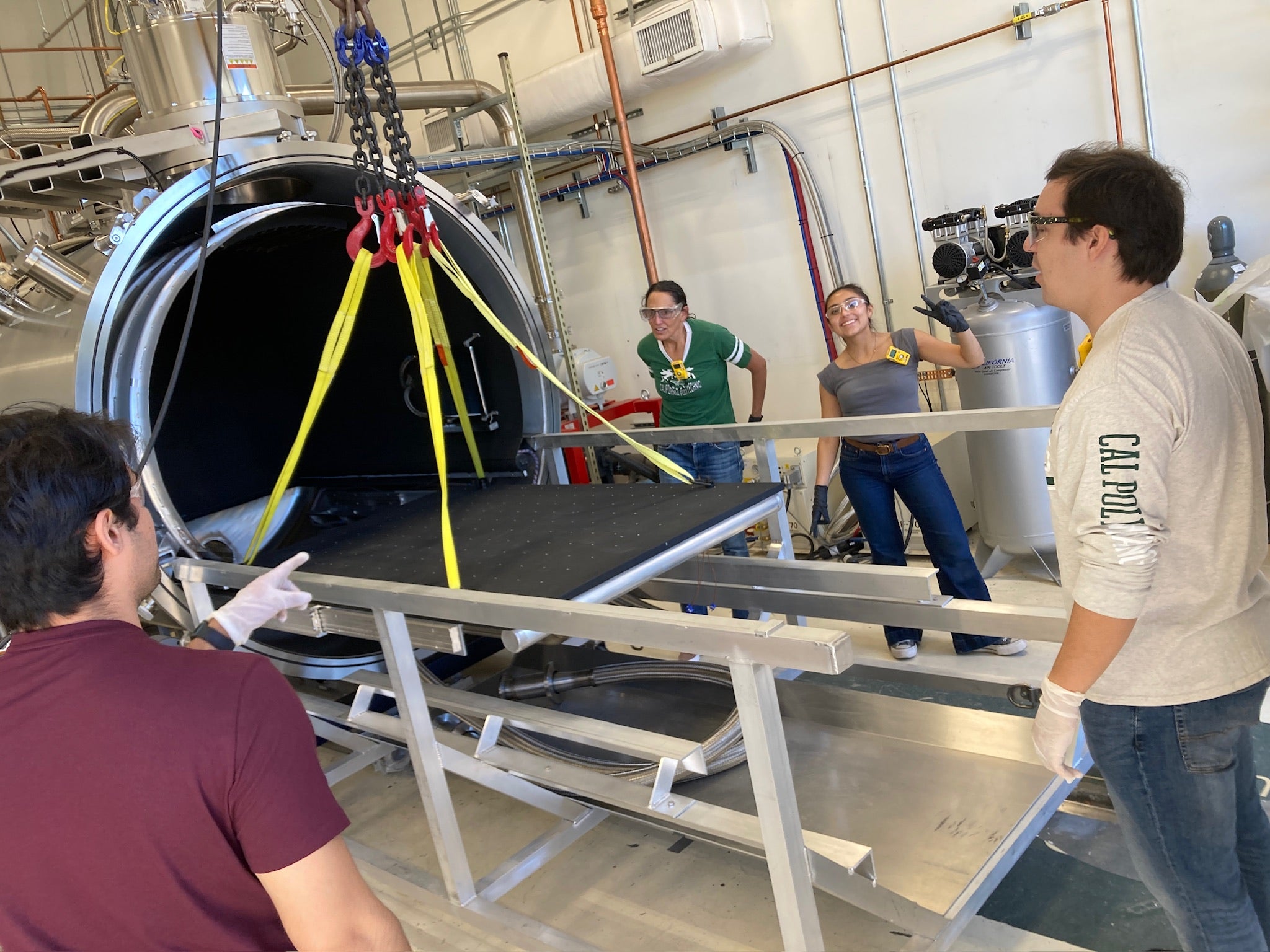
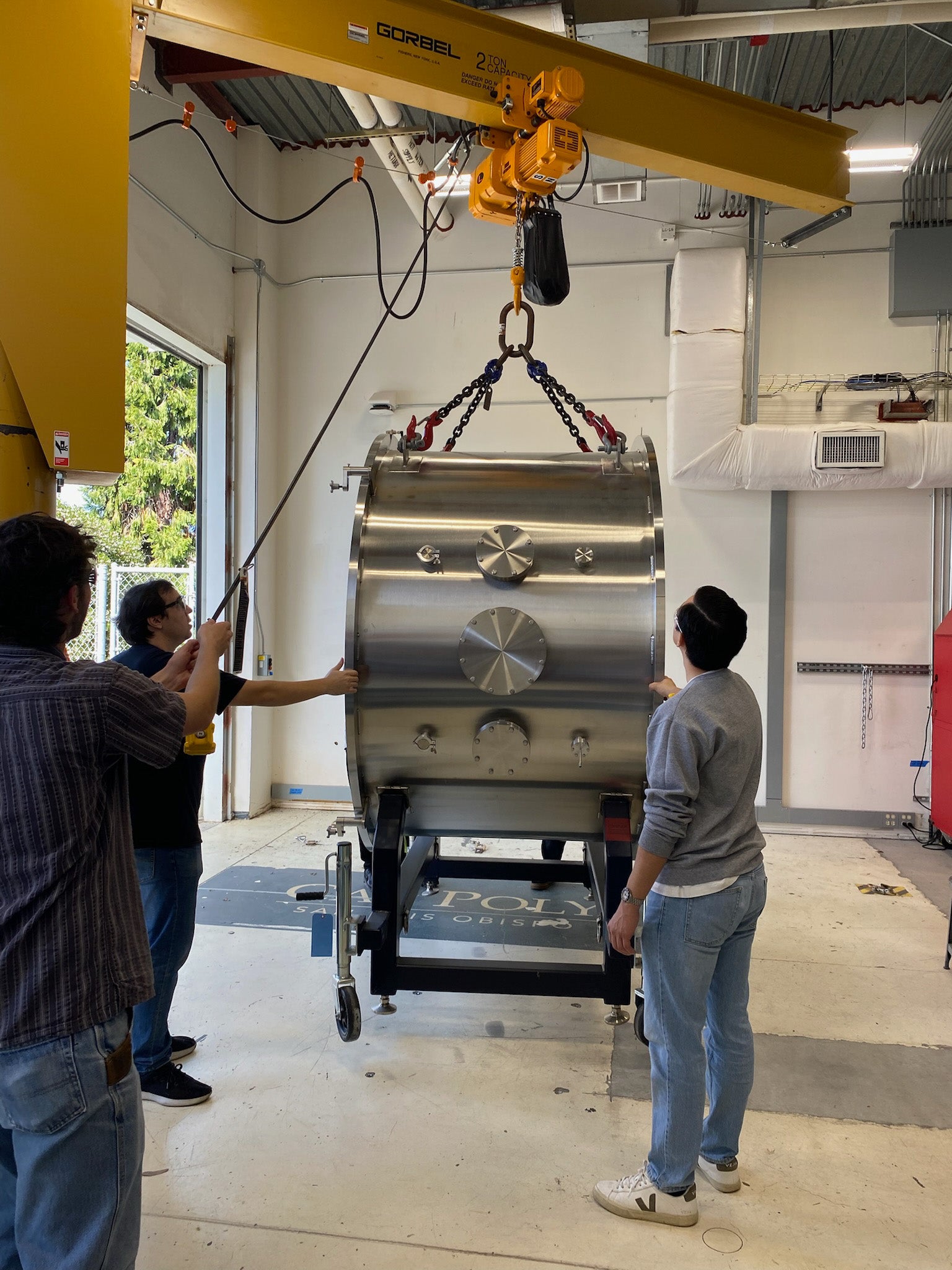
Procedures covered more than the chamber’s settings. Students monitored liquid nitrogen levels and trained on the jib crane used to move chamber hardware into place. Lieber said the team leaned into a safety culture, wearing oxygen monitors and safety glasses during shifts, and using a face shield and thick gloves during tasks such as “burping” the tank.
Abercromby described the work as a shared learning curve. Thermal vacuum testing wasn’t her background, she said, so she got up to speed with the students and worked through decisions as questions came up.
“I didn’t know how it all worked, so I was learning alongside the students,” she said. “We were making decisions together and asking questions like, ‘Does this make sense?’”
Opening the Doors
Access is the challenge now. Thermal vacuum chambers are in high use across California, Abercromby said, and limited availability can slow a company’s schedule when testing has to happen on a deadline. Chambers with STELLA’s size and capability are especially hard to find on the Central Coast, even with other thermal test equipment on campus.
“We’re oversubscribed in California,” she said. “A chamber like this would be the only one on the Central Coast.”
With STELLA’s long-duration run complete, the work is shifting toward customer readiness. Abercromby said companies have already reached out about thermal vacuum testing. Next comes turning the project’s procedures into a service the team can run on demand, with clear scheduling and costs.
Abercromby said the goal is a fee-for-service model, a faster path than a traditional research contract. The Aerospace Engineering Department has covered key costs so far, including liquid nitrogen and faculty time, while the team works through cost analysis to set rates that cover materials and labor.
With the service plan taking shape, attention is also turning to the chamber’s second configuration, electric propulsion testing. Aerospace engineering Associate Professor Lubos Brieda, who joined Cal Poly in the fall, is helping guide that next phase.
Powering the Next Phase
Chamber time can become the limiting factor in a development schedule, Brieda said, especially when government labs pause operations and testing slots disappear.
“This chamber gives the aerospace community a place to test flight hardware,” he said. “Availability can be a challenge.”
Brieda came to Cal Poly after working as an electric propulsion scientist at the Air Force Research Laboratory and a contamination control engineer at NASA’s Goddard Space Flight Center. Now he’s bringing that perspective to a facility still moving toward full capability, with plans to use the chamber as his research on plasma thrusters moves from simulation toward testing.
He said the chamber’s size also matters. It gives the team room to work with larger spacecraft components than many university facilities can accommodate and provides an opportunity to study how a thruster’s plume expands. That information can help mission designers avoid placing sensitive components where energetic ions could cause damage.
Just as important, Brieda said, is who gets to do the work. Undergraduate students aren’t just watching tests run; they’re learning the routines and responsibilities that typically show up later in a career.
“This is a unique proposition for Cal Poly,” he said.
The work didn’t end when the SURP project wrapped. Lieber has stayed on as one of Abercromby’s independent study students, helping reconfigure the chamber as the team moves toward electric propulsion testing.
“It’s an awesome thing to put on a resume,” she said. “And I get to keep doing it.”


